BP And Shell Join Deepwater Production Equipment Industry Initiative

Ed. Note: What could possibly go wrong?

http://www.lse.co.uk/AllNews.asp?code=zoccgbb1&headline=BP_And_Shell_Join_Deepwater_Production_Equipment_Industry_Initiative

LONDON (Alliance News) – BP PLC and Royal Dutch Shell PLC Monday signed an agreement to establish an industry initiative to develop a new generation of standardized, subsea production equipment designed to produce oil and gas from deepwater reservoirs.

The agreement, which also includes the US’s Anadarko Petroleum Corp and ConocoPhillips Ltd, was announced by US oil services company FMC Technologies Inc.


Posted in Uncategorized | Leave a comment

CEO says Shell is up for another try in Arctic

Legal challenges won’t stop company’s efforts, its leader says
By Jennifer A. Dlouhy   Houston Chronicle   July 31, 2014


http://www.houstonchronicle.com/business/energy/article/CEO-says-Shell-is-up-for-another-try-in-Arctic-5661413.php

Shell arctic oil rig


Posted in Uncategorized | Leave a comment

New Report Says Tesoro’s Track Record Raises Safety, Pollution Concerns About Proposed Plant on Columbia

By Kate Wilson  Willamette Week   July 10, 2014

anacortes-oil-refinery.-photo-by-ryan-healy-cc..nar


http://www.wweek.com/portland/blog-31845-new_report_says_tesoros_track_record_raises_

safety_pollution_concerns_about_proposed_plant_on_columb.html

Here are a few things Sightline points to that might cause residents to raise an eyebrow:

  • “Willful” violations in Anacortes refinery fire: After a deadly 2010 refinery fire in Anacortes killed seven workers, state and federal investigators blasted Tesoro, calling the company “complacent” about safety and issuing 39 citations of “willful” indifference to hazards at the site.
  • One facility, 4,000 clean air violations: The EPA says that Tesoro violated the Clean Air Act no fewer than 4,000 times at a single refinery in North Dakota and hundreds more times at other refinery locations. The company is among the top 100 toxic polluters nationally.
  • Oil spills and secrecy: When a Tesoro pipeline burst in 2013, the company did not bother to inform the affected landowner, who only discovered the spill after he noticed crude oil bubbling six inches high around the tires of his combine.
  • Hostility to safety investigators: Tesoro barred the gates to federal safety investigators after a burst pipe at a California refinery sprayed two workers in the face with sulfuric acid. Though the workers were helicoptered to a hospital and treated for burns, Tesoro called its employees’ injuries “minor.”
Posted in Uncategorized | Leave a comment

Tesoro alone in west coast petchem interest

Argus    Houston   1 Aug 2014

US refining peers show little interest in following Tesoro’s lead on a proposed west coast petrochemical project.

Tesoro is considering a $400mn project to increase mixed xylene (MX) extraction by 15,000 b/d at its 120,000 b/d refinery in Anacortes, Washington. The relatively minor upgrade would provide MX to be sold into the Asia market, where Tesoro estimates demand will grow by 5-7pc annually.

Because MX production uses refinery-produced reformate, which is otherwise used for gasoline production, the shift could also ease what refiners consider an oversupplied US west coast gasoline market. Tesoro plans to supply the MX project with reformate from Anacortes and delivered by water from its 168,000 b/d Golden Eagle refinery in Martinez, California.

But Phillips 66 and Valero, two west coast independent refiners who have also showed interest in expanding their chemicals businesses, did not plan to follow suit.

“I don’t think we’re looking at any chemicals investments on the west coast,” Phillips 66 chief executive Greg Garland said. “We don’t have any big investments on tap on the west coast.”

The US west coast and especially California present a tough investment case for independent refiners, let alone their shareholders.

Both Phillips 66 and Valero operate most of their refining on that coast in California, where state and local regulators can significantly slow a project. Phillips 66 and Valero have both struggled for more than a year to move logistics projects forward. Chevron has worked for nearly a decade to upgrade its 250,000 b/d refinery in Richmond, and will not under the best conditions complete the project before 2017.

“It would be tough to get permits, at the end of the day,” said Lane Riggs, Valero vice president of refining operations.

Valero only has California assets, while Phillips 66 operates a 100,000 b/d refinery in Ferndale, Washington. Even Washington has proven difficult for recent permits.

Tesoro acknowledged “strong headwinds” on its 360,000 b/d joint venture rail terminal with Savage in Vancouver, Washington. The refiner will need to seek construction permits from the state for the MX project.

Posted in Uncategorized | Leave a comment

Tesoro plans to boost xylene recovery at US West Coast

By OGJ editors  07/21/2014

Tesoro Corp. is planning a petrochemical feedstock project that will utilize production from its US West Coast refining operations to enhance xylene recovery at its 120,000-b/d Anacortes, Wash., refinery about 70 miles north of Seattle.

The $400 million project, which will involve gathering intermediate feedstock, primarily reformate, from its West Coast refining system, is designed to enable the Anacortes plant to recover up to 15,000 b/d of mixed xylene, the US independent refiner said in a July 21 release.

The mixed xylene mostly will be exported to destinations in Asia-Pacific, where regional demand is a primary driver in the global xylene market’s annual growth rate of about 5% to 7%, Tesoro said.

Pending permitting and approval, Tesoro said it expects the project to be commissioned in 2017.

A final investment decision on the project is due by yearend, the company said.

In addition to the Anacortes refinery, Tesoro’s US West Coast refining system also includes the 166,000-b/d Golden Eagle refinery at Martinez, Calif., a 363,000-b/d refinery at Los Angeles, Calif., and a 72,000-b/d refinery at Kenai, Alas.

Posted in Uncategorized | Leave a comment

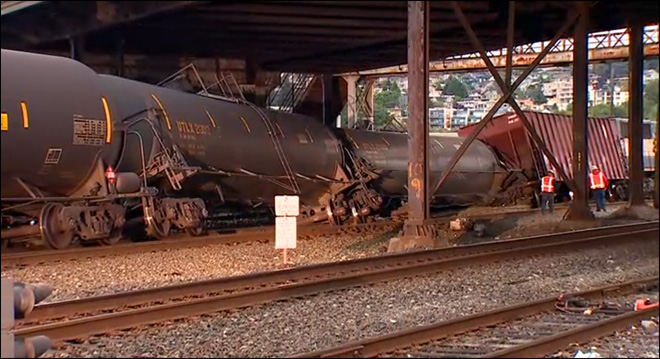
Oil train derails under Seattle’s Magnolia Bridge

By Associated Press KOMOnews.com Jul 24, 2014 PDT

http://www.komonews.com/news/local/Oil-train-derails-under-Seattles-Magnolia-Bridge-268442612.html

SEATTLE (AP) – Nothing spilled when three tanker cars in an oil train from North Dakota derailed at a rail yard early Thursday, but it alarmed environmentalists.

“This is a warning of how dangerous this could be,” said Kerry McHugh, communications director for the Washington Environmental Council.

She noted the train derailed near Puget Sound, under Seattle’s Magnolia Bridge, the main connection to one of the city’s neighborhoods.

“The potential for environmental damage, economic damage and the disruption of people’s lives is huge,” she said.

The train with 100 tanker cars of Bakken crude oil was heading for a refinery at Anacortes and pulling out of the Interbay rail yard at 5 mph when five cars derailed, said Burlington Northern Santa Fe spokesman Gus Melonas.

Seattle_train_derailment_660

Posted in Uncategorized | Leave a comment

Lightning Threatens Fracking Water Disposal Sites

By JOSH WOOD   Associated Press   7/21/14

http://www.chem.info/news/2014/07/lightning-threatens-fracking-water-disposal-sites

WILLISTON, N.D. (AP) — Three massive fires since the beginning of June have highlighted the threat lightning poses in the North Dakota oil patch, and in each case it was tanks that store the toxic saltwater associated with drilling — not the oil wells or drilling rigs — that were to blame.

The lightning-sparked fires destroyed the groups of silo-like storage tanks at the three locations, which are among more than 440 sites in North Dakota where so-called saltwater is stored before being pumped into permanent disposal sites miles underground. In each case, the fires burned for days, spewing noxious black smoke into the air and literally salting the earth.

Although disposal tanks aren’t likely more susceptible to lightning strikes than similar structures that jut out over the prairie, their fiberglass components and combustible contents make it very likely they’ll go up in flames when they are hit.

“You’re creating the perfect mixture for ignition,” said Bruce Kaiser, president of the Clearwater, Florida-based Lightning Master Corporation, which is one of several companies that provide lightning protection systems to oil field facilities. “Counterintuitively, it’s the water tanks that blow up, not the oil tanks.”

Also called brine, saltwater is a byproduct of oil production that is between 10 and 30 times saltier than seawater and that contains oil residue when it is put in the tanks, where gas vapors also collect. Companies allow the liquid to settle and separate, then skim and sell off the oil to pad their profits while injecting what remains into the ground.

Due to brine’s corrosiveness, companies would have to replace their disposal tanks every few years if they were just metal, so they commonly use tanks made of or lined with fiberglass, which last longer.

Metal-only tanks would allow the electricity to pass through them and into the ground more easily than those with fiberglass, said John Jensenius, a lightning safety expert at the National Oceanic and Atmospheric Administration.

“Because fiberglass is more resistant to electrical charge movement, it’s going to heat up. That’s why you’re seeing the fires,” he said.

Despite the risks posed by lightning, North Dakota doesn’t require companies to install any protections. Some do it anyway — the owner of tanks near the town of Ross that were struck June 27 estimates it will cost $2 million to replace them and clean up the site. But others apparently are unaware of the threat or are willing to take their chances to save money.

Kaiser, who said lightning can affect disposal tanks a quarter-mile away, said the protection systems his company installs can run $1,500 per tank, or less.

Protecting all of the tanks at a single site can run in the tens of thousands of dollars, but the cost of not doing so can be much greater, said Peter Carpenter, an executive vice president at another such company, Lightning Eliminators.

“When one tank goes, to be honest with you, it’s like a domino effect,” said Carpenter. “When one tank goes, you lose the majority of tanks in that battery.”

The fires destroyed nearly all of the storage tanks at the three North Dakota sites that have been struck since the start of June.

Only three of the 14 tanks were left standing after the fire at the site near Ross, where the roughly 24,360 gallons of oil was spilled or burned off and about 75,600 gallons of brine was spilled, according to the state. Alan Krenek, the chief financial officer for the site’s owner, Basic Energy Services, said it is standard procedure for the Fort Worth, Texas-based company to install lightning protection systems at its sites, but that it hadn’t been installed yet at that one.

But “just because you have lightning protection equipment on board doesn’t necessarily mean that it won’t happen,” said Krenek.

Indeed, the owners of the other two sites that burned say they had taken precautions, but to no avail.

The most recent, a July 7 strike at a facility next to a popular highway truck stop near the town of Alexander that burned for days, spilled about 118,146 gallons of brine and spilled or burned off roughly 27,258 gallons of oil. Fred Kershisnik, the president of the site’s owner, 1804 Operating, told The Associated Press that the site was grounded and the company thought it had taken all the steps to minimize the risks lightning posed, but will be reviewing how it protects sites.

A June 1 lightning strike on an Oasis Petroleum saltwater disposal facility in Williams County sparked a fire that completely destroyed the facility, spilling or burning off about 630 gallons of oil and about 50,400 gallons of brine. Oasis’ vice president of finance, Richard Robuck, told the AP that the company had implemented lightning prevention measures at the site before it was struck.

Continue reading

Posted in Uncategorized | Leave a comment

Map of Oil Refinery & Pipeline Health & Safety Issues

http://www.refinerymaps.com/

refinerymaps image

Posted in Uncategorized | Leave a comment

Important Meeting Tuesday 7/22

Richmond Chevron “Modernization” Project – City Council Tuesday 7/22

richmond meeting

 
Get there early to get a seat – 5:00pm Meeting starts at 6:30pm
403 Civic Center Plaza, Richmond, CA

Come support the Planning Commission proposal. You know Chevron will pack the house so please come and bring friends!

Posted in Uncategorized | Leave a comment

Slinger train derailment leads to evacuations

By Don Behm   Journal Sentinel   July 21, 2014

Dozens of homes in central Slinger in Washington County were evacuated Sunday evening after a train derailment prompted fears of a possible fire from diesel or other fuel.

Three engines and 10 railcars derailed, forcing the evacuation of more than 100 nearby homes, said Slinger Fire Department Chief Rick Hanke. Two people were being treated for injuries that are not life-threatening, he said.

The accident occurred southeast of the crossing of two separate freight rail lines — Wisconsin & Southern Railroad and Canadian National Railway Co. — at state Highway 144 in the village.

About 5,000 gallons of diesel fuel spilled from an engine, Hanke said. Hazmat crews had dikes and booms in place. Continue reading

Posted in Uncategorized | Leave a comment