Bay Area air board wants to cut refinery emissions 20 percent

http://www.contracostatimes.com/News/ci_26735323/Bay-Area-air-board-wants-to-cut-refinery-emissions-20-percent

By Denis Cuff    Contra Costa Times   10/16/2014

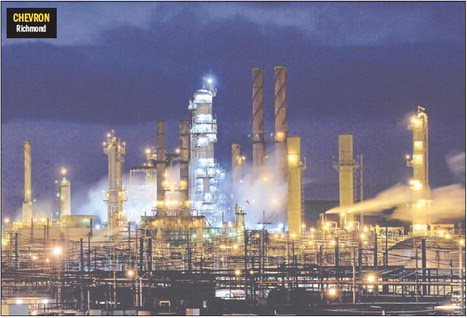
SAN FRANCISCO — Pushing the envelope on reducing air pollution, Bay Area air quality officials said Wednesday they want to cut oil refinery emissions by 20 percent.

Environmentalists called the plan a groundbreaking new approach, while industry leaders said it was radical and placed illegal restrictions on oil plants.

Though it set no deadline for reductions, the Bay Area Air Quality Management District board said it is steering a course to push oil refineries harder to upgrade equipment to cut emissions. Officials want a road map by December for considering new rules or procedures in 2015 to help meet the target. Refineries that show they already have the best and most modern equipment, and therefore could not meet the 20 percent requirement, could receive waivers.

“Refineries have made a lot of progress in reducing emissions as a result of aggressive rule making, but there is more work to be done,” said Contra Costa County Supervisor John Gioia of Richmond, also a regional air board member. “We know there is technology out there to do better.”

Continue reading

Posted in Uncategorized | Leave a comment

Oppose the Weak CBR Resolution of the City Council!

Dear Martinez Neighbors and allies:

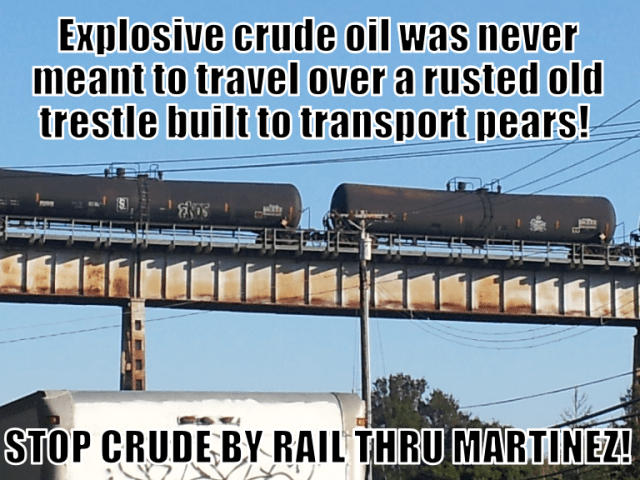
CBR Trestle

We need your voice at the Wednesday Martinez City Council to stop Bakken trains! The time has come…if you are concerned about explosive Bakken crude oil coming through Martinez every 7-10 days on its way to the Kinder Morgan railyard in Richmond (and then back to Tesoro by tanker trucks over Highway 4), we need you to make your voice heard at this week’s Martinez City Council meeting:

Wednesday, October 15, 7 PM
City Council Chambers
525 Henrietta Street (off Alhambra) in Martinez
On the agenda is a very weak resolution on “rail safety” introduced by Councilmember Menesini.  The proposed resolution does not include any provisions that the Martinez Environmental Group (MEG) has been advocating with the city for the past five months.   MEG is requesting that — like the cities of Davis, Berkeley and Oakland — Martinez needs to:
 – take a stand to oppose the passage of dangerous crude through our town
 – stay engaged and comment on local crude-by-rail projects that will                                     impact Martinez, as well as state and federal regulatory processes.
The proposal being considered on Wednesday does none of this.  It urges state and federal agencies to “be vigilant in enforcement and process” and expedite phaseout of older tank cars; the resolution also asks elected officials to enact legislation on safety.  The only action required by the resolution is that Martinez will “cooperate” with a vague and unspecified process on rail safety involving the California League of Cities. Compare the resolutions below.
This is completely unacceptable!  By introducing this resolution, our city leaders have failed to understand that:
– “safer” tank cars are already in use, but they have still derailed and caught fire.
– the City’s inability to commit to any real action on this issue is putting our entire town in danger.

We really need people to come and speak at public comment and/or show support in the audience.  Questions?  Email us at mrtenvgrp@gmail.com

For more information, compare the two resolutions below:

1) The MEG CBR resolution presented to the City Council in May of 2014 that they refuse to comment on. We have requested numerous meetings with council members to no avail. The link below includes a report with context for our desired resolution that was submitted to the Public Safety Subcommittee. https://mrtenvgrp.com/wp-content/uploads/2014/09/meg_cbr_sept_8_2014.pdf

2) City Council member Mike Menesini’s CBR resolution which is still in draft form and not on the agenda. We have alerted him that MEG is not in favor of such a watered down resolution.
http://martinez.granicus.com/MetaViewer.php?view_id=7&event_id=382&meta_id=80431

Thanks!

Posted in Come to Meetings, Uncategorized | Leave a comment

California Finally to Reap Fracking’s Riches [Editor’s Note: Not without a BIG fight!!!]

http://online.wsj.com/articles/california-finally-to-reap-frackings-riches-1412700677?

By ALISON SIDER and CASSANDRA SWEET

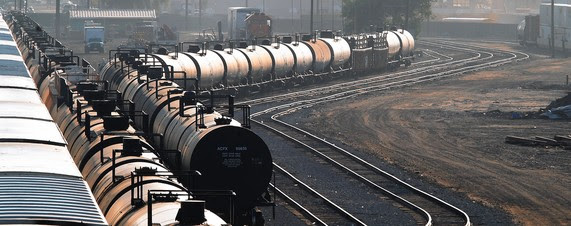
more oil cars

For the past decade, the U.S. shale boom has mostly passed by California, forcing oil refiners in the state to import expensive crude.
Now that’s changing as energy companies overcome opposition to forge ahead with rail depots that will get oil from North Dakota’s Bakken Shale. Thanks in large measure to hydraulic fracturing, the U.S. has reduced oil imports from countries such as Iraq and Russia by 30% over the last decade. Yet in California, imports have shot up by a third to account for more than half the state’s oil supply.

“California refineries arguably have the most expensive crude slate in North America,” says David Hackett, president of energy consulting firm Stillwater Associates.
Part of the problem is that no major oil pipelines run across the Rocky Mountains connecting the state to fracking wells in the rest of the country. And building pipelines is a lengthy, expensive process.

Railroads are transporting a rising tide of low-price shale oil from North Dakota and elsewhere to the East and Gulf coasts, helping to keep a lid on prices for gasoline and other refined products.
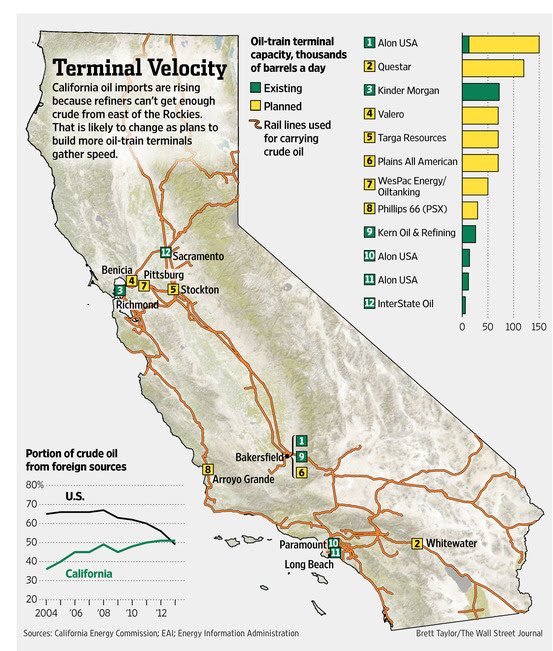
Yet while California has enough track to carry in crude, the state doesn’t have enough terminals to unload the oil from tanker cars and transfer it to refineries on site or by pipeline or truck.
Just 500,000 barrels of oil a month, or 1% of California’s supply, moves by rail to the state today. New oil-train terminals by 2016 could draw that much in a day, if company proposals are successful.

map

Continue reading

Posted in Uncategorized | Leave a comment

Hazardous Waste Dump in Martinez is up for Permit Renewal

Where is it?
The Acme Fill Corporation’s hazardous waste site is located at 950 WaterBird Way – east of 680, next to the Waterbird Preserve and less than a quarter mile from a densely populated neighborhood. The entire facility and buffer zones cover 516 acres.

What’s in it? The dump contains:
• Methylene chloride – predominantly used as a solvent and a “probable human carcinogen” according to US EPA.
• Trichloroethane (methyl chloroform) – long term inhalation exposure has caused heart problems, specifically ventricular arrhythmias.
• Tetrahydrofuran – highly flammable; prolonged exposure may cause liver damage.
• Acetone – highly water soluble, so it tends to leach to groundwater; long-term exposure in animals has led to kidney, liver, and nerve damage, birth defects, and lowered ability to reproduce in males.
• Alkaline sludge – possible petroleum refinery byproduct with variable composition.
• Sand blast waste – produced by removing rust or paint (could include lead paint).
• Catalyst fines – byproduct of oil refining, specifically the catalytic cracker.
Continue reading

Posted in Uncategorized | Leave a comment

Railroads say California lacks authority to impose safety rules on oil shipments

http://www.sacbee.com/2014/10/08/6770306/california-attorney-general-kamala.html

By Tony Bizjak and Curtis Tate   Oct. 8, 2014    Sacto Bee

The battle over crude oil trains in California intensified this week, reaching into the legal sphere with potential national repercussions.

The state’s two major railroad companies, Union Pacific and the BNSF Railway, went to federal court Tuesday to argue that neither California nor any other state can legally impose safety requirements on them because the federal government already does that.

The lawsuit came days after California Attorney General Kamala Harris joined other officials in challenging one crude-by-rail project, in the Bay Area city of Benicia. In a letter to Benicia officials, Harris said the city has failed to adequately analyze the potential environmental consequences of Valero Refining Company’s plan to ship two 50-car oil trains daily throughNorthern California to its Benicia refinery.

Those shipments would run through downtown Sacramento and other Valley cities.

The Valero project and similar plans by other oil companies prompted the state Legislature this summer to pass a law ordering railroad companies to submit an oil spill prevention and response plan to the state, and to provide proof to the state that they have enough money to cover oil-spill damages.

Railroads fired back this week, filing a lawsuit in the U.S. District Court in Sacramento. Their argument: Federal law pre-empts the state from imposing safety restrictions on the railroads.

The suit was filed by the two largest railroads in the Western United States, Union Pacific and BNSF Railway Co. The industry’s leading trade group, the Association of American Railroads, is listed as co-plaintiff.

The fight involves a long-standing friction point between railroads and U.S. states and cities. Railroads contend that local governments cannot place requirements or restrictions on freight travel because federal laws cover that ground.

The railroads have used the federal pre-emption argument to stop states from trying to impose speed limits on trains and ban certain types of shipments. In one notable case, railroads got the courts to overturn a Washington, D.C., law that attempted to ban trains carrying hazardous materials from using tracks within 2 miles of the U.S. Capitol.

“Federal law exempts this entire regime,” the railroads declared in the California lawsuit. Citing “a sweeping set of intricate federal statutes and regulations,” the lawsuit argues that allowing states to impose a “patchwork” of requirements on railroads essentially interferes with interstate commerce.

In a separate email statement Wednesday, BNSF spokeswoman Lena Kent said, “The state gives the industry no choice but to challenge the enforcement of the new law so as to not inhibit the efficiencies and effectiveness of the freight rail industry and the flow of commerce.”

Officials at the state Office of Spill Prevention and Response, the state agency listed as the defendant in the case, declined comment Wednesday, saying the agency does not publicly discuss pending litigation. Harris’ office is listed as a co-defendant.

The U.S. Department of Transportation in July proposed a rule that would require railroads to have oil spill response plans for trains carrying large volumes of crude oil. But that proposal could be months away from becoming law.

National transportation law and safety experts say the onus may be on California to prove that it is not usurping federal law or impeding interstate commerce.

“The state has to prove it is tackling what is a local or statewide issue, that it is not incompatible (with federal law) and doesn’t unreasonably burden interstate commerce,” said Brigham McCown, an attorney and former head of the federal Pipeline and Hazardous Materials Safety Administration. “That is a high bar.”

California might have an opening in a 2007 law Congress passed after the 9/11 Commission issued its recommendations. The 9/11 Act required rail companies to develop security plans and share them with state and local officials. The requirement was not limited to planning for a terrorist attack, but for any rail disaster, including derailments and spills involving hazardous materials.

“Those plans are required to be done and required to be shared,” said Denise Rucker Krepp, the former senior counsel on the House Homeland Security Committee, who wrote the provisions.

The Transportation Security Administration has not enforced the requirement, Krepp said, partly because of its focus on aviation security. But now that the railroads have taken California to court, Krepp said the state could use the 9/11 Act as leverage to get what it tried to get from the railroads through legislation.

“It’s never been tested like this,” Krepp said of the federal law.

It was unclear Wednesday whether the railroads also are challenging the section of the California law that imposes a 6.5-cent fee on oil companies for every barrel of crude that arrives in California on rail, or that is piped to refineries from inside the state. The resulting funds, estimated at $11 million in the first full year, will be allocated for oil spill prevention and preparation work, and for emergency cleanup costs. The efforts will be focused on spills that threaten waterways, and will allow officials to conduct response drills.

Crude-oil rail shipments have risen dramatically in the last few years. Those transports, many carrying an unusually flammable crude from North Dakota, have been involved in several spectacular explosions, including one that killed 47 residents of a Canadian town last year. Federal officials and cities along rail lines have been pushing for safety improvements. California officials have joined those efforts, saying they are concerned by estimates that six or more 100-car oil trains will soon be rolling through the state daily on the way to coastal refineries.

Harris, the state’s top law enforcement official, sent a letter to Benicia city planners challenging that city’s conclusion in an environmental impact report that the Valero rail shipment plan poses an insignificant threat of derailment. The report, she writes, “underestimates the probability of an accidental release from the project by considering only a fraction of the rail miles traveled when calculating the risk of a derailment.”

“These issues must be addressed and corrected before the City Council of Benicia takes action” on the project, Harris wrote.

Harris’ letter repeats earlier criticism leveled by the state Office of Spill Prevention and Response and state Public Utilities Commission.

The letter is one of hundreds Benicia has received in the past few months in response to the city’s initial environmental study. Benicia interim Community Development Director Dan Marks said the city and its consultants would review the comments and prepare responses to all of them, then bring those responses to the city Planning Commission for discussion at an as-yet undetermined date.

Under the Valero proposal, trains would carry about 1.4 million gallons of crude oil daily to the Benicia refinery from U.S. and possibly Canadian oil fields, where it would be turned into gasoline and diesel fuel. Valero officials have said they hope to win approval from the city of Benicia to build a crude-oil transfer station at the refinery by early next year, allowing them to replace more costly marine oil shipments with cheaper oil.

A representative for the attorney general declined comment when asked if Harris would consider suing Benicia to force more study of the project.

“We believe the letter speaks for itself,” spokesman Nicholas Pacilio said. “We expect it will be taken seriously.
Call The Bee’s Tony Bizjak, (916) 321-1059

Posted in Uncategorized | Leave a comment

Another derailment and explosion: Train carrying hazardous materials derails, catches fire in Saskatchewan

http://www.torontosun.com/2014/10/07/major-train-derailment-in-saskatchewan?utm_source=facebook&utm_medium=recommend-button&utm_campaign=Oil+tanker+explodes+after+major+train+derailment+in+
Saskatchewan

BzXVVZeCAAAiItX

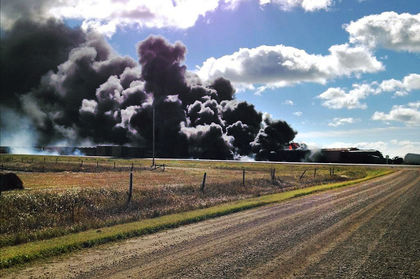
A freight train carrying hazardous materials derailed and caught fire in Saskatchewan on Tuesday, sending plumes of black smoke into the sky.

Several farms near the community of Clair, about 200 km east of Saskatoon, were evacuated, affecting about 50 residents.

Police closed a stretch of Highway 5 in both directions and kept people back for several kilometres, fearing toxic fumes.

Transportation Safety Board spokesman Rob Johnston said the agency is aware some of the derailed cars were transporting dangerous goods that were “combustible” and flammable.

It was not immediately clear Tuesday what they all were.

1297615310315_ORIGINALCN Rail told radio station CKNW that 26 of the train’s 100 cars jumped the tracks. Two of them containing petroleum distillate were in flames.

A team of TSB investigators were en route to the site Tuesday afternoon.

Posted in Uncategorized | Leave a comment

East Bay projects are redefining refineries

Upgrades: Projects to allow flexibility to respond to changing energymarkets, but environmentalists raise concerns

By Tom Lochner and Robert Rogers

chevron

The East Bay’s first oil refinery opened in 1896 near the site of Porkopolis-of-the-West, a defunct stockyard and slaughterhouse in the town of Rodeo. In the ensuing de­cades , four more East Bay refineries joined it, defining the region and powering its growth like no other industry.

A century later, the Contra Costa-Solano refinery belt, California’s largest, continues to cast an enormous shadow over surrounding cities, influencing their poli­tics, their economies, even their aesthetics. And at a time when fossil fuel seems like yesterday’s energy source, the Bay Area’s five refineries have all embarked on ambitious projects to transform the way they do business — and ensure their economic viability in a rapidly changing global energy market for decades to come. Continue reading

Posted in Uncategorized | Leave a comment

Register to VOTE! Make Your Green Voice Heard!


vote


Posted in Uncategorized | Comments Off on Register to VOTE! Make Your Green Voice Heard!

Democracy Now at Flood Wall Street

Featuring Bay Area Climate Activists David Solnit and Pennie Opal Plant!

Posted in Uncategorized | Leave a comment

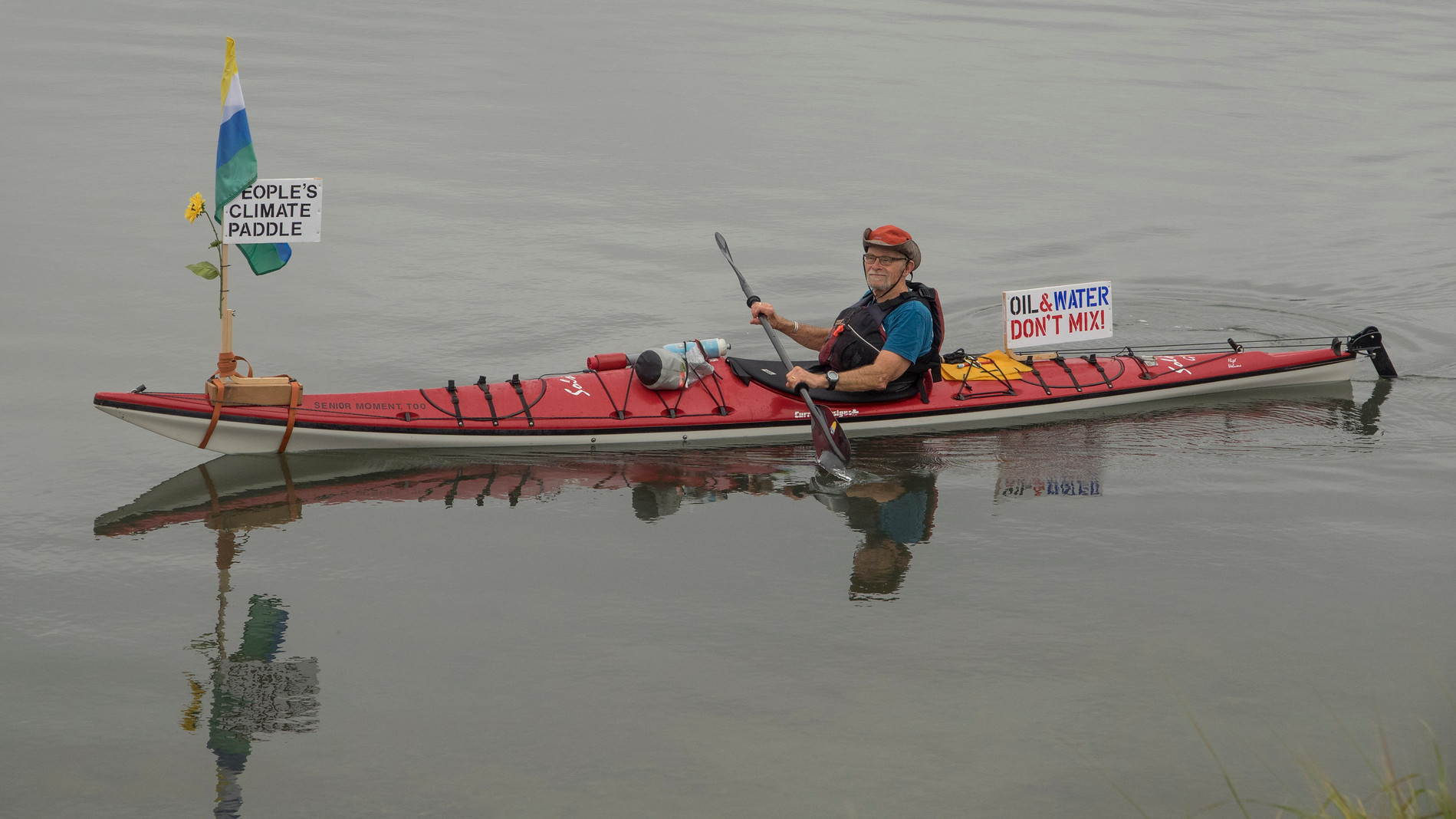
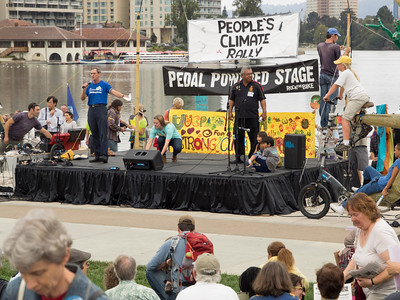
NORTHERN CALIFORNIA PEOPLE’S CLIMATE RALLY AT OAKLAND’S LAKE MERRITT PARK AMPHITHEATER

oak rally1oak rally3 oak rally2

Photos by Jack Owicki

Posted in Uncategorized | Leave a comment