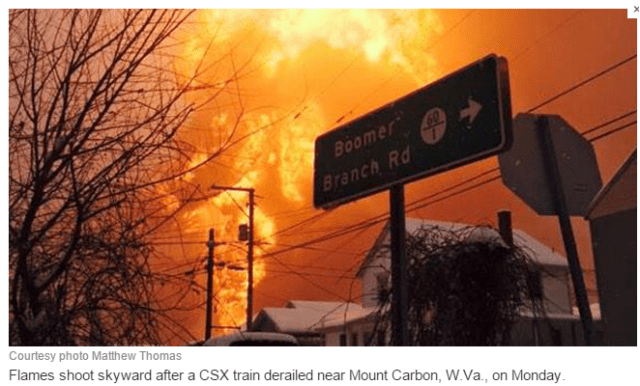
MOUNT CARBON, W.Va. — Multiple tanker rail cars carrying crude oil derailed Monday afternoon in Fayette County, triggering explosions and a 100-yard-high flames as several cars rolled through a residential subdivision and into the Kanawha River. CSX officials say “at least one rail car appears to have ruptured and caught fire.”
At least one house was destroyed, but police have found no evidence of fatalities. CSX says one person was treated for potential inhalation (of fumes).
CSX says its teams “are working with first responders to address the fire, to determine how many rail cars derailed and to deploy environmental protective and monitoring measures on land, air and in the nearby Kanawha River.
The an undetermined number of cars of the CSX train jumped the tracks at about 1:20 p.m. Eyewitness Randy Fitzwater of Boomer said he thought a plane had crashed.
“I heard this loud noise. It sounded like a jet airplane flew over my house and then I heard an explosion,” Fitzwater told Metronews. “I looked across the river and I could see this big ball of flame.” (Listen to Fitzwater’s full interview above.)
Another eyewitness, who declined to give her name, told Metronews “the flames were going at least 300 feet in the air … black smoke everywhere.” She reported hearing several explosions “that shook my whole house. I could feel the heat through my door.”
Gov. Earl Ray Tomblin’s office said the tanker cars were carrying highly flammable Bakken crude from North Dakota to Yorktown, Va. Governor’s spokesman Chris Stadleman said it was unclear what caused the derailment or how many cars tumbled into the river.
State Public Safety spokesman Larry Messina said first responders had trouble reaching the scene because of road conditions from the snowstorm and the derailment itself.
Mount Carbon residents in the Adena Village area, which is just a few miles from Montgomery on state Route 61, were being evacuated. Residents across the river in Boomer also were told to leave their homes.
An evacuation shelter was set up at Valley Elementary School in Smithers, W.Va. CSX said it is working with the Red Cross and other relief organizations to address residents’ needs, taking into account winter storm conditions.
With water intakes at Montgomery and Cedar Grove closed, residents were asked to conserve water.
West Virginia American Water reported the intake for the Montgomery water treatment plant, which draws water from the Kanawha River a few miles downstream from the derailment, was shut down by 2:30 p.m. Spokeswoman Laura Jordan said the Montgomery treatment plant “was shut down before anything could reach the intake.”
CSX says “The train consisted of two locomotives and 109 rail cars and was traveling from North Dakota to Yorktown, Va.” Governor Tomblin’s office said the train was hauling Bakken crude.
Bakken crude produced in the booming regions of Montana and North Dakota could be more flammable and more dangerous to ship by train than crude from other areas, U.S. regulators announced in January. A four-month study by the Pipeline and Hazardous Materials Safety Administration could force more rigid labeling of contents and require petroleum to be shipped in stronger rail cars.
(Reuters) – At tense meetings just days before the first major U.S. refinery strike in 35 years was called on Sunday, union leaders grew increasingly pessimistic about getting a new labour contract and a sizable wage increase.
“The chances of there being an agreement are that of a snowball in hell,” one of them complained as the deadline imposed by the expiring contract loomed.
Officials from Royal Dutch Shell Plc (RDSa.L)(RDSa.N), the lead negotiator for the oil companies, were repeatedly saying it would be too hard to meet the union’s demands for a new three-year contract to lift pay and tighten safety practices, several union officials told Reuters.
But what most frustrated the United Steelworkers union (USW) was something they had never seen before: an intransigent Shell.
The USW had always viewed Shell as the most flexible of the big oil companies, much easier to negotiate with than Exxon Mobil Corp (XOM.N) or Marathon Petroleum Corp (MPC.N). In fact, the union picks the company to head up negotiations and specifically chose Shell this year for its perceived flexibility .
“We were very, very shocked,” USW International President Leo Gerard said about Shell’s decision to cut off talks on Sunday.
“Shell has been a responsible lead company in years past. We have been able to have rational, reasonable negotiations with them,” Gerard told Reuters on Monday.
A Shell official declined to comment on the details of the labour negotiations. Before it suspended talks, Shell had made five offers that were all rejected by the union.
Late on Monday, Shell said it had resumed contact with the union “in hopes of coming to a mutually satisfactory contract agreement.” The USW said on Tuesday that no meetings have been scheduled for new contract negotiations.
Oil industry executives said they were surprised at how tough going the talks were, adding that representatives from the national union appeared to be taking a harder line than local union leaders.
Disagreements over how to monitor worker fatigue, which is tied to accidents, were especially thorny, they said.
Unlike in previous negotiations, there is a “big disconnect” between the locals and the national union, according to two refining executives.
A text message seen by Reuters sent by the union to its members on Jan. 25 said companies were “play(ing) games” at local negotiating tables.
HISTORY OF FLEXIBILITY
Shell had forged deals with the union in 2006, 2009 and 2012. Those contracts were considered successes, especially after a months-long walkout in 1980, a time people still talk about as a low point for disputes in the sector.
This year, however, was different. John Abbott took over as Shell’s refining chief in 2013 and Ben van Beurden became chief executive officer in 2014.
This time, there were new faces on the negotiating team from Shell, and a 50 percent slide in oil prices CLc1 LCOc1 since June cast a shadow over the talks as companies slashed spending.
Feeling they had no other option, the union called a strike at nine plants with a combined 10 percent of U.S. refining capacity.
Mystified by Shell’s change in tone from previous contract talks, some striking workers on Monday said they think that oil companies, seeing that many older refinery workers are retiring, are trying to test the strength of younger union members.
Cutting off talks that began Jan. 21 may have just been a ploy, they said, so that the companies can push for a deal that limits new costs – a move that would please shareholders.
Indeed, some people picketing on Monday near Houston said Shell may have given the union a big head fake and that the company would soon reopen talks.
The union is seeking annual pay raises of 6 percent, double the size of those in the last agreement. It also wants work that has been given in the past to non-union contractors to start going to USW members, a tighter policy to prevent workplace fatigue, and reductions in members’ out-of-pocket payments for healthcare.
[Editor’s note – Amazingly, there are no pictures yet from the scene! Hmmmm…]
By ERIC ATKINS The Globe and Mail
Sunday, Feb. 15 2015, 10:23 AM EST, updated Sunday, Feb. 15 2015, 3:47 PM EST
A Canadian National Railway Co. train carrying 100 tank cars of crude oil derailed and caught fire in Northern Ontario early Sunday morning.
A CN spokesman said there were no injuries in the derailment that happened around midnight on Saturday about 80 kilometres south of Timmins, Ont., on the CN mainline in a remote area inaccessible by road.
MORE RELATED TO THIS STORY
Government to intervene as CP strike threatens economy
CN Rail reaches tentative deal with train engineers union
Railways search for a means to meet rising demands
Twenty-nine cars jumped the tracks and seven were still on fire on Sunday afternoon.
Rob Johnston, an investigations team manager with the Transportation Safety Board, said the train was travelling eastbound at 40 miles an hour when the crew felt an impact and saw flames about 10 cars behind the locomotive. They halted the train and detached the engines and pulled ahead, according to safety procedures.
The TSB investigators, who are not yet on the scene, will face difficult conditions determining the amount of any spill and the cause due to the site’s remote location and the cold weather, Mr. Johnston said in an interview.
“There is a fire at the scene,” said CN’s Patrick Waldron. “CN has initiated its emergency response plan and has crews responding to the site. That includes firefighting and environmental crews and equipment.”
The train was visually inspected and went through a checkpoint that automatically detects mechanical problems 20 miles before the derailment. The track was visually inspected on Saturday and cleared by a rail flaw detector in the past week, Mr. Waldron said.
The increase in the amount of crude moving on the rails has raised safety concerns that were highlighted by the 2013 tragedy in Lac Megantic, Que., where a runaway train derailed, exploded and killed 47 people. Since then, governments in Canada and the United States have begun phasing in tougher crash standards for tank cars and lower speeds for oil trains. But several trains carrying oil and other petroleum products have crashed and caught fire since the tragedy in Lac Megantic, including derailments in New Brunswick and Saskatchewan in 2014.
Oil producers have increasingly used trains to move crude amid a shortage of pipeline space, and to enjoy the flexibility railways offer. The plunge in oil prices has dampened growth in the crude-by-rail business since the fall, but the number of trains carrying oil is expected to rise this year as new terminals are opened.
For CN, hauling crude and related products accounts for less than 10 per cent overall revenues, a similar amount as that of Canadian Pacific Railway Ltd.
Via Rail said it has cancelled passenger rail service between Toronto and Winnipeg until the rail line has been cleared. Via said it will offer alternate arrangements for those already en route or due to travel Sunday.
A refinery in Los Angeles, seen from the predominantly Hispanic neighborhood of Wilmington. One reason Hispanics may be concerned about global warming is that they often live in areas directly exposed to pollution.CreditMonica Almeida/The New York Times
WASHINGTON — Alfredo Padilla grew up in Texas as a migrant farmworker who followed the harvest with his parents to pick sugar beets in Minnesota each summer. He has not forgotten the aches of labor or how much the weather — too little rain, or too much — affected the family livelihood.
Now an insurance lawyer in Carrizo Springs, Tex., he said he was concerned about global warming.
“It’s obviously happening, the flooding, the record droughts,” said Mr. Padilla, who agrees with the science that human activities are the leading cause of climate change. “And all this affects poor people harder. The jobs are more based on weather. And when there are hurricanes, when there is flooding, who gets hit the worst? The people on the poor side of town.”
Leadership would be for public figures to treat environmental issues with importance, not waiting for poll-tested sound bites.
Mr. Padilla’s concern is echoed by other Hispanics across the country, according to a poll conducted last month by The New York Times, Stanford University and the nonpartisan environmental research group Resources for the Future. The survey, in which Mr. Padilla was a respondent, found that Hispanics are more likely than non-Hispanic whites to view global warming as a problem that affects them personally. It also found that they are more likely to support policies, such as taxes and regulations on greenhouse gas pollution, aimed at curbing it.
A garlic field in Cantua Creek, Calif. A record drought in 2014 threatened hundreds of thousands of acres of farmland in the Central Valley.CreditMatt Black for The New York Times
The findings in the poll could have significant implications for the 2016 presidential campaign as both parties seek to win votes from Hispanics, particularly in states like Florida and Colorado that will be influential in determining the outcome of the election. The poll also shows the challenge for the potential Republican presidential candidates — including two Hispanics — many of whom question or deny the scientific basis for the finding that humans caused global warming.
Among Hispanic respondents to the poll, 54 percent rated global warming as extremely or very important to them personally, compared with 37 percent of whites. Sixty-seven percent of Hispanics said they would be hurt personally to a significant degree if nothing was done to reduce global warming, compared with half of whites.
And 63 percent of Hispanics said the federal government should act broadly to address global warming, compared with 49 percent of whites.
A greater percentage of Hispanics than whites identify as Democrats, and Democrats are more likely than Republicans and independents to say that the government should fight climate change. In the poll, 48 percent of Hispanics identified as Democrats, 31 percent as independents and 15 percent as Republicans. Among whites, 23 percent identified as Democrats, 41 percent as independents and 27 percent as Republicans.
Over all, the findings of the poll run contrary to a longstanding view in politics that the environment is largely a concern of affluent, white liberals.
“There’s a stereotype that Latinos are not aware of or concerned about these issues,” said Gabriel Sanchez, an associate professor of political science at the University of New Mexico and director of research at Latino Decisions, a survey firm focused on the Hispanic population. “But Latinos are actually among the most concerned about the environment, particularly global warming.”
One reason, Mr. Sanchez and others said, is that Hispanics often live in areas where they are directly exposed to pollution, such as neighborhoods near highways and power plants.
Hispanics typically rate immigration, education and employment in the top tier of the policy issues on which they vote, but the poll is the latest in a growing body of data showing that Hispanics also care intensely about environmental issues.
A 2013 poll by the Pew Research Center found that 76 percent of Hispanics agreed that the earth had been warming, and 59 percent attributed that warming to human activity. By comparison, 62 percent of whites agreed that the earth had been warming, and 41 percent attributed that to human activity.
A 2014 study in the scientific journal PLOS One found that nationally, minorities were exposed to concentrations of the toxic pollutant nitrogen dioxide that were 38 percent higher than what whites faced. Nitrogen dioxide is linked to respiratory illness and, like planet-warming carbon dioxide, is spewed from vehicle tailpipes and power plant smokestacks. While it is not directly linked to global warming, populations that experience high levels of exposure to it are likely to be more supportive of pollution regulation, Mr. Sanchez said.
The nationwide poll was conducted Jan. 7 to 22 using cellphones and landlines by The Times, Stanford and Resources for the Future. Interviews were in English or Spanish with 1,006 adults, including 738 non-Hispanic white adults and 103 Hispanic adults. The margin of sampling error is plus or minus four percentage points for non-Hispanic white adults and 12 percentage points for Hispanic adults.
The combined results have been weighted to adjust for variation in the sample relating to geographic region, sex, race, Hispanic origin, marital status, age, education and, for landline households, the number of adults and number of phone lines. In comparing subgroups, The Times reports only poll results that are statistically significant.
Tony Vazquez of San Jose, Calif., a poll respondent and a former truck driver who now makes nickel plates for car parts, said in a follow-up interview that he would support policies such as national taxes on greenhouse gas pollution.
The result, Mr. Sanchez and other researchers said, is that politicians should be wary of dismissing the issue of climate change. “The most important thing is that candidates have to think about the Latino population as complex,” Mr. Sanchez said. “To ignore the environment is to ignore something that a large section of the Latino population sees as important.”
Republican political strategists were skeptical.
“The real issue here is whether a dollar spent fighting climate change is better than a dollar spent improving schools, health care or national security,” said Whit Ayres, a Republican pollster. “Most Republicans are going to find greater political advantage in promoting credible plans to strengthen the economy, improve education and make progress on a host of other issues, including immigration, rather than climate change.”
In Florida, a state that will be crucial to presidential candidates, Nicole Hernandez Hammer, a sea-level rise researcher of Cuban-Guatemalan descent, is working to raise awareness of climate change among Hispanic voters. Last month, she was invited to sit in the first lady’s box during Mr. Obama’s State of the Union address.
Of Hispanics’ growing interest in climate change issues, Ms. Hammer said: “We’re not at rallies. Latinos in immigrant communities are more concerned about putting food on the table.”
But, she said, “We know that our communities are disproportionately more vulnerable to the impacts of climate change, so when it comes time to vote, we make our voices heard on the issue.”
Dear Friend of Sea Shepherd,On Valentine’s Day Eve, Friday, February 13th, Sea Shepherd’s Cove Guardians and supporters around the world will join together for the second annual “World Love for Dolphins Day,” to hold peaceful demonstrations against Taiji, Japan’s brutal capture and slaughter of dolphins. As Valentine’s Day nears, thousands of people are preparing to bring the world’s love and reverence for dolphins to Japan’s doorstep at Japanese embassies and consulates across the United States and overseas. Join us in San Francisco!
For six months of each year — from September until March — entire family units, or pods, of dolphins and small whales are driven into Taiji’s killing cove. The dolphins and whales face brutal slaughter, a lifetime in captivity, or in a drive just as stressful as the drive into the cove, remaining pod members must endure an exhausting drive back out to sea. Operation Infinite Patience aims to bring a permanent end to the drive hunts and slaughter.WHAT: World Love for Dolphins Day 2015 WHEN: Friday, February 13th 10:00PM — 2:00PM WHERE: Consulate General of Japan
275 Battery Street, San Francisco, CA 94111
or watch the Livestream from your computer
by Lynn DoanBarbara Powell 9:21 AM PST Bloomberg Business
(Bloomberg) — The largest U.S. refinery strike since 1980 was set to drag on for at least another week as contract talks stalled between the union representing 30,000 oil workers and Royal Dutch Shell Plc, bargaining on behalf of companies.
Negotiations between the United Steelworkers and Shell, representing companies including Chevron Corp. and Exxon Mobil Corp., were suspended until Feb. 18 after a meeting that ran past 6 p.m. New York time on Tuesday failed to produce an agreement, said two people familiar with the negotiations, asking not to be identified because the information isn’t public. Shell spokesman Ray Fisher said on Wednesday that he wasn’t sure when the company was meeting with USW leaders next.
A recess in negotiations threatens to prolong a strike at nine U.S. refineries accounting for about 13 percent of the country’s processing capacity. It’s the first national strike by U.S. oil workers since 1980, when a walkout lasted three months. One of the sites affected has halted production, and a full strike of USW members would threaten to disrupt 64 percent of U.S. fuel output.
The United Steelworkers said in a statement late Tuesday that “there was little progress” made in its last meeting with Shell.
USW says strike is expanding to two more plants due to unfair labor practices by oil companies
The United Steelworkers union said on Saturday the strike by U.S. refinery workers is expanding to two more plants early on Sunday due to unfair labor practices by oil companies.
Walk-outs at BP Plc’s Whiting, Indiana, refinery and the company’s joint-venture refinery with Husky Energy in Toledo, Ohio, on Sunday would bring the number of plants with striking hourly workers to 11, including nine refineries accounting for 13 percent of U.S. refining capacity.






 Martinez Environmental Group