Minor fire extinguished at Shell Martinez, Calif. refinery

Fri Mar 13, 2015 4:28pm EDT

(Reuters) – A small fire was extinguished at Shell’s 156,400 barrel-per-day refinery at Martinez, California on Friday, news website mercurynews.com reported.

The fire broke out at about 9 am (local time) and was quickly put out by the company employees.

There were no injuries, the report said quoting Shell spokesman Steve Lesher.

The fire did not impact refinery operations, the report added.

Posted in Uncategorized | Leave a comment

Refinery deal struck, gasoline prices set to fall

http://www.contracostatimes.com/breaking-news/ci_27700553/refinery-deal-struck-gasoline-prices-set-fall

By George Avalos    03/12/2015

MARTINEZ — Shell Oil and the United Steelworkers have reached a tentative agreement on a national contract, a deal that eventually could push gasoline prices lower and pave the way to end a walkout at several fuel factories, including the Tesoro Golden Eagle Refinery in Martinez, union and industry analysts said Thursday.

The tentative deal was confirmed Thursday by Jim Payne, a spokesman for USW. Local 5, which represents about 425 unionized workers at the Golden Eagle Refinery.

“We are pleased that the USW. and Shell reached agreement on the pattern for the industry,” said Tina Barbee, a spokeswoman for Tesoro.

Bargaining involving Local 5 was under way on Thursday, although details weren’t available. Terms of the new tentative four-year contract weren’t immediately known.

The Tesoro refinery is shown Dec. 13, 2003. in Martinez. (Jose Carlos Fajardo/Bay Area News Group)

“Tesoro remains committed to direct, good faith discussions with USW. local representatives and we will work toward ratification of local agreements at our represented locations,” Barbee said.

The Tesoro refinery in Martinez has been idled since nearly the beginning of the walkout. It has 650 employees and can process 166,000 barrels of oil a day.

Tesoro had begun a planned maintenance at the Martinez plant prior to the start of the strike. Once the United Steel Workers included the Tesoro Golden Eagle Refinery in the strike, Tesoro decided to idle all of the units at the refinery and extend the maintenance efforts.

About 4,000 workers at nine plants, including seven refineries accounting for 10 percent of U.S. refining capacity, have been on strike since early February in California, Kentucky and Texas. The California refineries involved are the Tesoro plants in Martinez and Carson in Los Angeles County.

“Gasoline prices are set to go lower in the coming weeks,” said Allison Mac, a spokeswoman for GasBuddy.com, an online site that tracks the fuel markets.

Gasoline prices have been relatively stable over the past week, Mac said.

On Thursday, gasoline prices were at $3.40 a gallon in Santa Clara County, down from $3.41 a week ago; $3.38 in the East Bay, down from $3.40 a week ago; and $3.49 in the San Francisco-San Mateo-Marin region, unchanged from a week ago, according to GasBuddy.

“Since we see an end to the strike, it’s looking good for consumers,” Mac said.

Contact George Avalos at 408-859-5167. Follow him at Twitter.com/georgeavalos.

Posted in Uncategorized | Leave a comment

Trains in Canada derailments carried synthetic crude for Valero

http://www.reuters.com/article/2015/03/10/canada-derailment-crude-idUSL1N0WC15020150310

Reuters Tue Mar 10, 2015

(Reuters) – The two oil trains that derailed and burst into flames in recent weeks in northern Ontario were both carrying synthetic crude to Valero Energy Corp’s refinery near Quebec City, the U.S.-based company said on Tuesday.

Saturday’s CN Rail derailment came less than a month after another CN train carrying oil went off the tracks and ignited in northern Ontario. The railway had said both were carrying crude from Alberta, but declined to give their exact destination.

"We take safety very seriously, so we’re concerned anytime there’s an incident," said Valero spokesman Bill Day. "Despite the number of rail incidents recently, it is very rare for cargo not to be delivered to its destination safely."

Day said all of the rail companies Valero works with, including CN Rail, have good safety records.

Synthetic crude is produced from Alberta’s oil sands in upgrader plants, and usually commands a premium to conventional crudes because it is lighter and easier to refine into valuable byproducts such as gasoline.

Valero’s Jean Gaulin refinery is in Levis, across the St. Lawrence River from Quebec City.

In May 2013, the company said it would build a rail off-loading facility at the Jean Gaulin refinery so it could start using Western Canadian crude rather than relying on pricier imports. The company told Reuters it would take light, sweet Western Canadian crude rather than heavier oil sands crude.

Shipments of North American crude to the refinery ramped up early last year. On a July earnings call, the company said North American grades made up 83 percent of the refinery’s feedstock in the second quarter of 2014, up from 45 percent in the first quarter and 8 percent higher than a year earlier.

Separately on Tuesday, CN spokesman Jim Feeny said the train that derailed in February had been carrying petroleum distillates in addition to synthetic crude.

"The contents of the tank cars are a subject of interest and the TSB will be testing the contents to determine what they were," said John Cottreau, spokesman for Canada’s Transportation Safety Board, which is investigating the incidents.

In a note to shippers on Tuesday, CN said a temporary bypass track would likely be completed by late afternoon, reopening its main line in northern Ontario. (Reporting by Allison Martell in Toronto, and Scott Haggett and Nia Williams in Calgary; Editing by Alan Crosby)

Posted in Uncategorized | Leave a comment

America is literally on fire: How out-of-control oil spills are destroying our population centers 

http://www.salon.com/2015/03/ 10/america_is_literally_on_ fire_how_out_of_control_oil_ spills_are_destroying_our_ population_centers/#comments

By DAVID DAYEN   TUESDAY, MAR 10, 2015    Salon.com

Disasters are raging with such force and regularity that
firefighters have to give up. Welcome to the new reality 
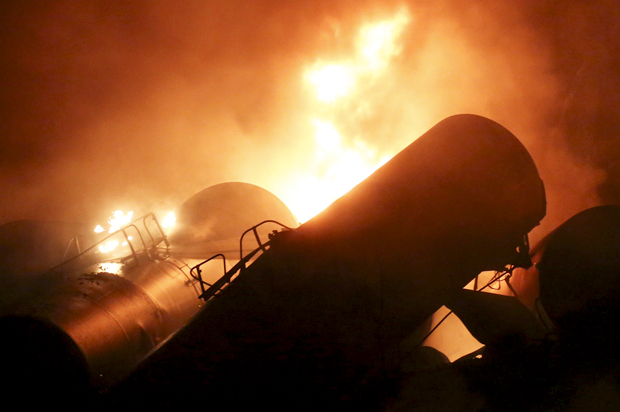
A CSX Corp train burns after derailment in Mount Carbon, West Virginia, February 16, 2015.  (Credit: Reuters/Marcus Constantino)

A CSX Corp train burns after derailment in Mount Carbon, West Virginia, February 16, 2015. (Credit: Reuters/Marcus Constantino)  

It’s a good bet that someplace in North America is on fire right now, raging so out of control that officials have to let it burn itself out. And it happened because highly flammable oil was placed on a train for shipping, and something went drastically wrong. Because so much oil is transported by rail these days, the probabilities of catastrophe have elevated significantly. We haven’t ruined a major population center yet only through dumb luck; and we haven’t cracked down on this treacherous practice only because of the enormous power of the industry.

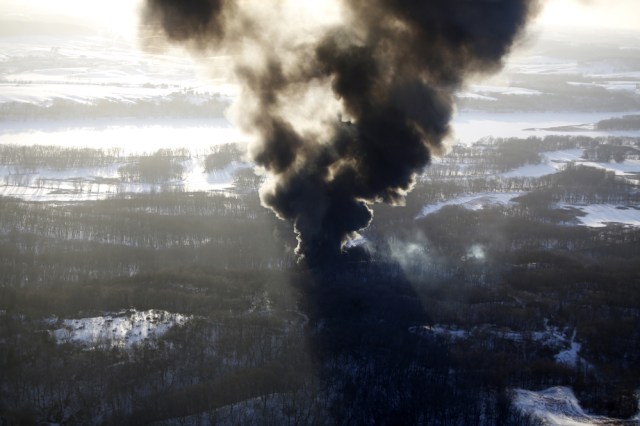
Last Thursday, 21 oil tanker cars derailed near Galena, Illinois, and five of them burned for three days. Firefighters gave up combating it because of the intensity of the heat. Tanks tumbled into a bank along the Mississippi River, threatening the Upper Mississippi National Wildlife and Fish Refuge. The EPA said the fire posed an “imminent and substantial danger” to the river. On Saturday, another train caught fire near Gogama, Ontario, damaging a bridge and sending five tank cars into the water. A similar train fire occurred on Feb. 14 near the Ontario town of Timmis, and on Feb. 16 in the almost perfectly named town of Mount Carbon, West Virginia. In all, over the past five weeks there have been five crude oil train derailments, threatening ecosystems and human health. You can follow all the “action” at the DOT-111 Reader.

The industry estimates that 9,500 carloads of oil moved along rail lines in 2008. In 2014 that number jumped to 500,000 carloads, transporting 15 billion gallons of crude. By some estimates that could double this year. Moreover, harder-to-reach oil, from the Bakken shale of North Dakota to the tar sands of Alberta, Canada, is more flammable and explosive, igniting at much lower temperatures, according to U.S. regulators.

The exponential increase of shipping more dangerous product just magnifies the risk. These trains – or bombs on wheels, if you prefer – pass through big cities like Philadelphia, Seattle, Newark and Chicago. A derailment in a big city would be very destructive; when the relatively tiny town of Lac-Mégantic, Quebec (population 5,932), suffered a runaway train explosion in its downtown in 2013, 47 people died and $1.2 billion in property was damaged, making it the worst train disaster in Canada since 1864. So continuing to run these trains through major cities is like lighting a fuse to dynamite.

Oil companies pledged a commitment to safety by improving the quality of the tank cars, replacing thin-skinned DOT-111 cars with a new model called CPC-1232. But that hasn’t mattered a bit; the Galena derailment involved these allegedly safer CPC-1232s, as have several other recent tragedies.

Those who respond to oil train derailments by claiming that the Keystone XL pipeline would solve the problem neglect the fact that a pipeline would not be able to carry even half of what flows from the Bakken region. More important, because of the collapse in oil prices, new infrastructure like a pipeline has ceased to make economic sense, relative to the existing infrastructure of transporting by rail.

Perhaps the scariest part of all of this is the perilous financial state of the oil industry today, which if anything will increase the danger. Energy companies are rapidly going bankrupt, as they cannot service debt with lower oil revenue. Companies on the edge will have to cut costs to keep afloat, and when costs are at issue, traditionally safety goes out the window.

What can be done about these massive explosions-in-waiting currently traipsing around the country? The Department of Transportation did propose new rules last July, to phase out the old DOT-111 cars, increase speed limit requirements and improve brakes. They plan to finalize those rules in May, after missing an initial deadline. But DoT’s proposal did not include a rule that oil companies remove explosive gases, including excess natural gas, from their shipments. A state version of that rule in North Dakota is supposed to take effect April 1.

According to a report in Reuters, the White House considered a provision to remove these volatile gases (known in the industry as “light ends”), but ultimately punted, letting North Dakota rules govern. Federal officials were concerned about their jurisdiction to dictate treatment of light ends. But critics believe the federal government relying on North Dakota – a conservative state not exactly known for its strict adherence to regulations – increases the risk of shipping oil by rail. That’s especially concerning when you consider that the trains travel all across the country, and that some Bakken shale comes from neighboring states like Montana. For their part, the White House denied they held off on improving oil train safety.

Sen. Chuck Schumer urged federal regulators to mandate the removal of light ends from crude oil in a letter last week, and Dick Durbin, whose state was charred by the Galena disaster, called for strengthening tank cars. There are indications that the Galena tank cars, though the stronger CPC-1232, were “unjacketed,” without insulated steel shells.

The DoT regulations will finally emerge from the Office of Management and Budget’s internal process in May. Officials at the Office of Information and Regulatory Affairs, which analyzes federal regulations for OMB, held at least 10 meetings with the oil and rail industries last spring, after initially receiving the rules. That includes meetings with the biggest oil-by-rail company, BNSF, a division of Warren Buffett’s Berkshire Hathaway. Basically, the oil companies point to track maintenance, and the rail companies point to inadequate tank cars. Whatever doesn’t cost them money is what they blame.

Increased domestic oil production is always depicted as an unalloyed good, with no discussion of the costs, like turning trains into bombs nationwide. There’s reason to believe that no tank car is safe enough to carry something this volatile, and that the risks exceed what the public should reasonably bear. DoT has nonchalantly predicted 10 derailments a year on oil trains, with billions in damages. If anything that’s an underestimate.

One reason the planet continues to boil is that oil companies have been allowed to externalize their costs onto government. Oil appears “cheaper” than solar or wind, because these costs never come into account. But solar power doesn’t blow up while being carried through a major city on a train. And if we want to seriously talk about what kind of energy we can afford in the future, that has to enter the conversation.
David Dayen is a contributing writer for Salon. Follow him on Twitter at

Posted in Uncategorized | Leave a comment

Exxon Misrepresents Torrance Refinery Safety Record and Explosion’s Effect on Gas Prices to Lawmakers at Town Hall Hearing, Consumer Watchdog Says

NEWS RELEASE

Exxon Misrepresents Torrance Refinery Safety Record and Explosion’s Effect on Gas Prices to Lawmakers at Town Hall Hearing, Consumer Watchdog Says

March 9, 2015

Contact: Liza Tucker, Phone Number: 310-392-7931, 626-372-1964 (cell)

Santa Monica, CA —Exxon misrepresented its safety record at its Torrance refinery to lawmakers at a public hearing at Torrance City Hall last week, suggesting its February 18 explosion and fire was unique, and did not acknowledge how extensively the blast damaged its ability to supply gasoline, Consumer Watchdog said today.

“The fact is that ExxonMobil’s Torrance facility has had numerous accidents involving hydrocarbon fumes that ignited,” said Consumer Watchdog advocate Liza Tucker. “The company has paid more than $15 million in fines for violations of state and federal air standards at its Torrance refinery and terminals since 2005, but these fines are just a cost of doing business.”

At the hearing, Torrance refinery manager Brian Ablett maintained that, “There hasn’t ever been another incident similar to this at Exxon Mobil.”  According to media reports, the Torrance facility had suffered or caused at least five accidents involving hydrocarbon fumes:

 •In 1979, a driver on Van Ness Avenue ignited refinery vapors that drifted over and was killed by the fireball.

•In 1984, superheated oil from a leaky pipe covered cars, homes and clothing and 2,500 people filed damage reports.

•In 1987 a petroleum gas line explosion tied to equipment malfunctions touched off a blaze that took 150 firefighters to extinguish.

 •In 1994, a butane gas explosion touched off by a leak from a disconnected pipe injured 28 people when safety measures were not followed.

•In 1999, a broken pipeline spilled isobutane and modified hydrogen fluoride, hospitalizing three workers.

 “We have OSHA, which levies fines on behalf of workers,” said Tucker. “But refineries are never sanctioned for endangering or hurting local residents—they always get a free pass. Until criminal provisions are applied to refineries, and corporations and their managers are held responsible for knowingly endangering workers and the public, business as usual will continue.”

At the hearing, Ablett maintained that a processing unit called the Fluid Catalytic Cracker was shut down at the time of the explosion and that the accident was centered in a filtration system called an Electrostatic Precipitator, built to air regulators’ specifications, that extracts particulate matter and other byproducts. “It was particularly strange there was an explosion,” he told regulators.

 In fact, refinery workers were repairing a damaged compressor in the Fluid Catalytic Cracker while leaving the cracker partially running, said Bob van der Valk, Senior Editor of the Bakken Oil Business Journal. “They should have shut it down instead. They made an economic decision, and it was the wrong one.” Van der Valk said that hydrocarbon fumes built up in a line leading to the Electrostatic Precipitator, which caused the explosion.

According to van der Valk, a new problem in the crude unit has completely shut down the refinery’s ability to refine gasoline. “They are out of the gasoline refining business for four to six months while they repair the unit,” he said.

 “This sort of misrepresentation and omission of information about safety, infrastructure, and the ability to supply gasoline is why refinery managers should be required testify under oath,” said Tucker.

Posted in Uncategorized | Leave a comment

Still Burning

Yesterday's derailment in Galena, Ill is still burning.

Yesterday’s derailment in Galena, Ill is still burning.

Posted in Uncategorized | Leave a comment

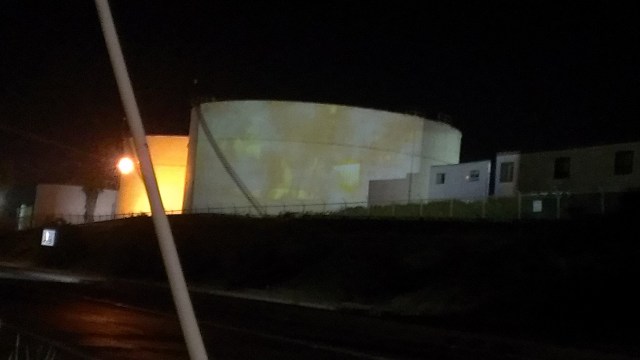
Strike Supporters Project Images onto Tesoro Tanks, 3-6-15

IMAG2037

A message that oil workers and environmentalists can agree on! Photo: T. Griffith

IMAG2044

Anacortes Tesoro explosion projected onto Tesoro tank in Martinez. Photo: T. Griffith

IMAG2045

Climate Movement Supports Refinery Workers!

IMAG2055

Chevron Richmond 2012 explosion. Photo: T. Griffith

IMAG2061

Remember this black cloud moving over Richmond and beyond?

IMAG2073

Greg Karas of Communities for a Better Environment (CBE) Photo: T. Griffith

IMAG2093

Ron Espinoza, Staff Representative at United Steelworkers Photo: T. Griffith

IMAG2074

Author Antonia Juhasz Photo: T. Griffith


Posted in Uncategorized | Leave a comment

State agencies mobilize after crude oil train derails near Galena

http://chicago.suntimes.com/transportation/7/71/417253/bnsf-train-carrying-crude-oil-derails-galena

Smoke from a fiery BNSF crude oil train derailment near Galena, Ill., is seen from the Chestnut Mt. Resort. | Image from lifestream video

Smoke from a fiery BNSF crude oil train derailment near Galena, Ill., is seen from the Chestnut Mt. Resort. | Image from lifestream video

Posted: 03/05/2015, 05:10pm | Associated Press
GALENA, Ill. (AP) — A BNSF Railway freight train containing 103 cars loaded with crude oil has derailed near the northern Illinois city of Galena.

According to railroad officials, the train derailed around 1:20 p.m. Thursday in a rural area where the Galena River meets the Mississippi.

Galena City Administrator Mark Moran said city fire crews responded to the derailment 3 miles south of the city.

“The report that came back to me from them is that eight tanker cars had left the track,” Moran told the Dubuque Telegraph Herald. “Two of those were still upright. The other six were not.”

Jo Daviess County Sheriff’s Sgt. Mike Moser says several cars have caught fire as a result of the derailment. Authorities are evacuating a 1 mile radius around the crash site as a precaution, according to the sheriff’s office.

Gov. Rauner has activated the State Incident Response Center and has sent personnel from several state agencies to the site of the derailment.

irefighters could only access the derailment site by a bike path, said Assistant Fire Chief Bob Conley. They attempted to fight a small fire at the scene but were unable to stop the flames.

Firefighters had to pull back for safety reasons and were allowing the fire to burn itself out, Conley said. In addition to Galena firefighters, emergency and hazardous material responders from Iowa and Wisconsin were at the scene.

The cause of the derailment hasn’t been determined, said BNSF spokesman Michael Trevino, adding railroad employees are on the scene and additional personnel were headed to the scene and would work with local responders.

The train’s destination wasn’t immediately known.

Posted in Uncategorized | Leave a comment

Join us! March 5, 6:30-8PM, Solano Way and Arnold Industrial Way

safER2

At the United Steel Workers Local 5 Picket
CARPOOL: CAN YOU GIVE A RIDE OR NEED A RIDE TO THE EVENT?
http://www.groupcarpool.com/t/n4xmkt

MAP/DIRECTIONS: just click on “Get Directions” and enter your address.
http://mapq.st/1BJVsBZ

United Steelworkers (USW) refinery workers are on strike over serious health and safety concerns. Workers cite outsourcing, short staffing, forced overtime that produces dangerous fatigue, and a lack of stop-work authority protections to prevent dangerous refinery accidents. Now in it’s 5th week, it is their first strike since 1980 against the most wealthy industry in history.

Featuring:
GUERRILLA MOVIE PROJECTIONS: San Francisco Projection Department will project outdoor movies and images at the picket line of the refinery entrance.

SPEAKOUT: Hear from striking refinery workers and members of refinery community, environmental and climate justice groups about their common fight for health and safety.

ANTONIA JUHASZ: Leading oil industry expert Antonia Juhasz will give a comprehensive analysis of why big oil industry is threat to the health and safety of workers, communities, the environment and our climate and why refinery workers demands for safety are a key part of the solution. In her March 2 L.A. Times Op Ed Juhasz writes,
“The most important thing is to shelter in place, stay indoors, no outdoor activity, turn the air conditioners off, keep the windows closed.” This was the instruction Torrance Mayor Patrick Furey gave to neighbors of the Exxon Mobil refinery, including the children at 14 schools, for three hours following a massive explosion at the facility Feb. 18. The ExxonMobil refinery explosion in Los Angeles Feb. 18 was the third U.S. refinery explosion this year, and just the latest reminder of the very real dangers petroleum refineries and terminals pose for their workers, their neighbors, the air we breathe and the climate we share. In fact, at least 50 workers have died in U.S. refinery incidents since 2007, according to my research. During the same period, according to the United Steelworkers, a fire or explosion has put refinery workers and communities at risk twice a month, on average, at facilities across the nation. Before there’s another Torrance, or Richmond, or another clean-air violation or refinery death, the demands of the striking workers should be met, the concerns of communities heard..”

Posted in Uncategorized | Leave a comment

CSX softens outlook for crude by rail shipments amid price slump

BY JARRETT RENSHAW   March 4 Wed Mar 4, 2015

(Reuters) – CSX Corp has softened its growth projections for crude rail shipments as a sustained price slump has weakened demand, a company executive said Wednesday.

In January, company executives were optimistic that the rout in U.S. crude oil prices – which have been slashed by more than half since the summer – would not put a halt to its growing crude rail business, which has surged in recent years thanks to high demand from East Coast refiners.

But at two recent public events, the latest at JP Morgan’s Aviation, Transportation & Industrials Conference in New York on Wednesday, company executives said things have changed.

“Our crude growth will continue, but probably not at the level that we had originally anticipated due to the lower crude prices,” Chief Financial Officer Fredrik Eliasson said.

Last month, Eliasson said in a speech that customers have told the company that low crude oil prices are weakening demand, putting downward pressure on growth.

CSX spokeswoman Melanie Cost said that despite the weakening projections, the company still expects year-over-year growth, but at a “more moderate pace than we’ve seen the past several years and more moderately than originally anticipated.”

The company does not disclose detailed projections for its crude rail business, which more than doubled in 2014, according to a presentation by CSX at the New York conference on Wednesday. (Reporting by Jarrett Renshaw in Philadelphia; editing by Matthew Lewis)

Posted in Uncategorized | Leave a comment