
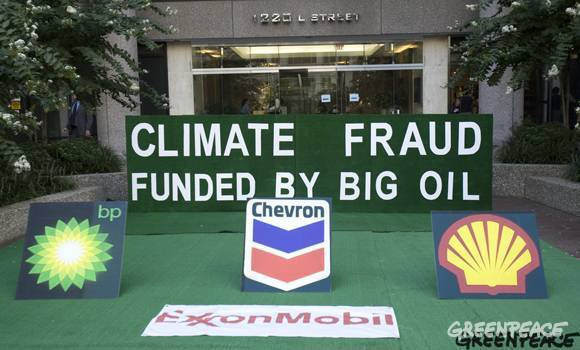
Photo by Greenpeace
Photo by Greenpeace
Environmentalists say presumption of global temperature rise to 4C undermines multinational’s ability to talk with authority on climate change

‘Shell No’ protesters take to the water on Saturday heading near Royal Dutch Shell’s Polar Pioneer drilling rig near Seattle. Photograph: David Ryder/Getty Images
Royal Dutch Shell has been accused of pursuing a strategy that would lead to potentially catastrophic climate change after an internal document acknowledged a global temperature rise of 4C, twice the level considered safe for the planet.
A paper used for guiding future business planning at the Anglo-Dutch multinational assumes that carbon dioxide emissions will fail to limit temperature increases to 2C, the internationally agreed threshold to prevent widespread flooding, famine and desertification.
‘Don’t mention the Arctic’: Shell embarrassed by video competition row
Read more
Instead, the New Lens Scenarios document refers to a forecast by the independent International Energy Agency (IEA) that points to a temperature rise of up to 4C in the short term, rising later to 6C.
The revelations come ahead of the annual general meeting of Shell shareholders in the Netherlands on Tuesday, where the group has accepted a shareholder resolution demanding more transparency about the group’s impact on climate change.
5/12/15 – Last night, the Martinez Unified School District took a strong stand against the explosive Bakken crude-by-rail that is currently allowed to travel through Martinez. Acknowledging that there are five Martinez public schools within the one-mile “blast zone,” the School Board unanimously supported a resolution that:

Over the past year, Bakken trains have been travelling on the BNSF rail line from Stockton to Richmond several times a month. Although the trains have been on hold due to low crude prices, recent price per barrel increases suggest the trains could resume at any time. These are the same trains that have derailed, exploded and burned for days elsewhere in the country; the most recent incident was less than a week ago in North Dakota. Despite the clear danger, the BAAQMD permit allowing these trains to unload at the Kinder Morgan rail yard was issued “ministerially;” that is, without any public hearing or notice whatsoever.
The Martinez school board’s decision last night is the most significant action ever taken here in Martinez by an elected official on the issue of crude-by-rail, despite extensive advocacy by local residents. The resolution is available here:
http://martinez-ca.schoolloop.com/file/1338041184424/1381823027387/5387089778102994800.pdf

Protesters gather at the rally against the proposed Kinder Morgan oil pipeline on Burnaby Mountain, November 17, 2014. (Photo: Mark Klotz)
Monday, 27 April 2015 By Melina Laboucan-Massimo, 50.50 Op-Ed
Protesters gather at the rally against the proposed Kinder Morgan oil pipeline on Burnaby Mountain, November 17, 2014. (Photo: Mark Klotz)
On April 11, 2015 there were dozens of rallies across Canada demanding true leadership to deal with the climate crisis we face around the world. The federal Harper government continues to be a climate laggard refusing to address the need to reduce our carbon emissions and violate Indigenous peoples rights with its zealous pro-tar sands agenda. For the first time in Quebec, Indigenous peoples led the march to show our resolve to protect the sacredness of Mother Earth and demand justice. As I stood before a crowd of 25 000 people from across Canada, I spoke of the contamination, despair and detrimental impacts my family and many other communities face from resource extraction happening in our homelands of Northern Alberta.
Due to being an Indigenous activist who speaks out against environmental destruction I have been labelled by the Canadian government as an “adversary.” Both “Aboriginals” and “environmentalists” were labelled as such in 2012 when secret government documents were accessed through the Freedom of Information Act. And now the Harper government is taking this to yet another extreme by attempting to pass an anti-terrorism law called Bill C-51 which includes targeting the “anti-petroleum movement” as “extremists” because they oppose “critical infrastructure” projects like the tar sands and tar sands pipelines. This bill is an attempt to silence people who do not agree with the Harper government and can be used to target and criminalize democratic peaceful protest movements. Over 100 legal experts expressed deep concern calling the bill “a dangerous piece of legislation” and addressed an open letter to all members of parliament to amend Bill C-51 or kill it. It is legislation like this that makes it difficult for people to not be scared into silence and for people like me who believe that we need to transition to clean and just work and engage in peaceful protests that may be seen as criminal in the eyes of the Canadian government. But this history is not new for us as Indigenous peoples here in Canada. It is the continuation of neo colonialism seen now in the form of resource extraction, environmental and cultural genocide.
The traditional territory of my ancestors and my Nation of the Lubicon Cree covers approximately 10,000 square kilometres of low-lying trees, forests, rivers, plains, and wetlands – what we call muskeg – in northern Alberta. For three decades, our territory has undergone massive oil and gas development without the consent of the people and without recognition of our treaty & Indigenous rights, which are protected under Section 35 of the Canadian Constitution.
In the 1970s, before this encroachment on the land began, my father’s generation and my grandparents’ generation survived by hunting, fishing, and trapping throughout the region. Back then, and even into my own generation, people were still living off the land. I remember going out on the trapline, and I remember when the water was still good to drink. But as oil and gas have come through the territory, that’s changed.
Currently there are more than 2,600 oil and gas wells in our traditional territories. Over 1,400 square kilometres of leases have been granted for tar sands development in Lubicon territory, and almost 70 per cent of the remaining land has been leased for future development.
Where there once was self-sufficiency, we are seeing increased dependency on social services as families are no longer able to sustain themselves in what was once a healthy environment with clean air, clean water, medicines, berries, and plants from the Boreal. Our way of life is being replaced by industrial landscapes, polluted and drained watersheds, and contaminated air. And it’s very much a crisis situation.
In the North, we are seeing elevated rates of cancers and respiratory illnesses as a consequence of the toxic gases being released into the air and water. And while over $14 billion in oil and gas revenues have been taken from our traditional territory, our community lives in extreme poverty and still lacks basic medical services and running water.
Unceded Territory
Canada’s treatment of the Lubicon has been repeatedly condemned by the United Nations, and UN Special Rapporteur Miloon Kothari has called for a moratorium on oil and gas in Lubicon territory.
On March 26, 1990, the United Nations Human Rights Committee ruled that Canada’s failure to recognize and protect Lubicon land rights violated the International Covenant on Civil and Political Rights. In 2006, the United Nations Human Rights Committee again called on Canada to address outstanding land claims in Lubicon territory before granting further licences for economic exploitation, yet this resource extraction is still happening.
In 1899, when Treaty 8 was officially signed in northern Alberta, treaty commissioners overlooked the Lubicon Cree due to their remote and hard-to-reach territory. The Lubicon people therefore never ceded their traditional territory to the Crown. This has led to a precarious and unstable relationship with both the provincial and federal governments as both have continuously undermined the sovereignty of the Lubicon people. For decades the Lubicon have tried to settle these outstanding land disputes, but unfortunately it serves the government’s interests to keep the Lubicon land claim outstanding due to the territory’s rich oil and gas deposits.
When the construction of an all-weather road began in the early 1970s, the Lubicon people started to contest the encroachment of their traditional territory as multinational corporations began to exploit the land. For the 14 years that followed, the Lubicon attempted to assert their rights through various court proceedings at both the provincial and federal level. By 1988, the Lubicon concluded that it was necessary to use other means of direct action so their voices and message would be heard.
On October 15, 1988, the Lubicon people erected a peaceful blockade, which was successful in stopping oil exploitation of the territory for six days. Only then did Alberta Premier Don Getty meet with the Lubicon chief and agree to a 243-kilometre reserve under the Grimshaw Accord.
Despite this agreement, the Canadian government offered the Lubicon substandard conditions in the land settlement agreement. Even Premier Getty described the offer as “deficient in the area of providing economic stability for the future.”
Unfortunately, due to the take-it-or-leave-it approach of the federal government, the land claim negotiations continued from 1989 until 2003 when the talks broke down completely and both parties walked away from the table. To this day, the Lubicon Cree have been unable to settle a land claim, which has drastically hindered their ability to protect themselves and their traditional territory from further exploitation and destruction.
The Rainbow Pipeline Rupture
On April 29, 2011, a rupture in the Rainbow Pipeline resulted in a spill of about 4.5 million litres of oil in our territory – one of the biggest oil spills in Alberta’s history. When the pipeline broke, oil went down the corridor and into the forest, but the majority of it was soaked up into the muskeg, which is like peatland moss and takes thousands of years to be generated. The muskeg is not an isolated system. It’s not “stagnant water,” as the government claims. It’s actually a living, breathing ecosystem that supports life and is connected to all the water in the region.
On the first day of the spill, the school was not notified. When students started to feel sick, they were evacuated from the school under the assumption that it was a propane leak. When they got outside into the field, they realized that the problem was throughout the community.
The first week of the spill, community members experienced physical symptoms: their eyes burned, they had headaches, they felt nauseous. We were told that air quality was not a problem, even though Alberta Environment didn’t actually come into the community until six days after the spill. This is problematic since the government granting permits for this type of development to happen, often without the consent of the people, has an obligation to take care of those whom they are directly putting at risk. A lot of people were left wondering what they should do, and if pregnant women and small children should even be in the community.
The Rainbow Pipeline is now 45 years old. When it broke in 2006 and spilled 1 million litres of oil, the Alberta Energy and Utilities Board stated that stress and corrosion in the pipeline’s infrastructure contributed to the spill. Five years later, 4.5 million litres spilled in our traditional territory. We’re also seeing pipeline breaks like this in other parts of North America, from Kalamazoo, Michigan, to the Kinder-Morgan spill along the West Coast. Will it ever end?
How many more communities have to be put at risk for this type of development, and who is really benefiting? What are we leaving to future generations? We need to shift away from a fossil fuel-based system and push for renewable energy systems that enable us to be self-sufficient and self-sustaining.
For over a century now, the Lubicon Cree’s rights have not been protected or respected. For decades the Lubicon have led local, national, and international lobbying efforts to fight for what is inherently theirs and to protect their right to their land and to clean air and good water. But despite years of raising awareness and increasing exposure, the Lubicon people still wait for justice.
However, over the past decade of speaking out and demanding justice I have seen a great shift in how our struggles are perceived. Now people from all walks of life are beginning to stand together and seek justice for those first and foremost impacted on the frontlines of environmental destruction. Now more than ever, people are working together as we know that the fate of humanity is wrapped up in our collective fight for a better, more just world for all.
This piece was reprinted by Truthout with permission or license. It may not be reproduced in any form without permission or license from the source.
MELINA LABOUCAN-MASSIMO
Melina Laboucan-Massimo is from Northern Alberta and a member of the Lubicon Cree First Nation. She works as an advocate for Indigenous rights, and for the past eight years she has worked against unabated tar sands extraction and expansion as a Climate and Energy campaigner with Greenpeace in Alberta, as well as with the Indigenous Environmental Network internationally.
FRIDAY, APRIL 24, 2015 BY TOM HAYDEN
Originally published by the San Francisco Chronicle on April 24, 2015

Lost Hills, CA (Photo: 2015 David McNew, Getty Images)
Jerry Brown perhaps should put his DOGGR to sleep. Not his family dog, Sutter, but DOGGR — the Division of Oil, Gas and Geothermal Resources — the 100-year-old agency that’s been handing out permits for drilling in the Central Valley without records, oversight or enforcement of 21st century environmental laws.
The agency was created prior to Upton Sinclair’s 1927 novel, “Oil!,” on which Daniel Day-Lewis’ 2007 film, “There Will Be Blood,” was based. Oil was to California what cotton was to Mississippi, a booming industry based on subsistence labor, migration, racism, vigilantism, and government officials looking the other way.
Times change but slowly. Current Kern County Sheriff Donny Youngblood, who says Kern ought to be a county in Arizona, opposes President Obama’s immigrant-rights policy. There are an estimated 66,000 undocumented immigrants in Kern County, whose population is majority Latino. More than 22 percent of its people live below the poverty line, 69 percent of them within one mile of an oil well.
The barren place is a bit like Mississippi in the ’60s, powerful enough to defy progressive norms or laws on the national level. The federal government in 1982 transferred its power to California to monitor and regulate the 42,000 injection wells that dump toxic waste fluids into groundwater. That monitoring didn’t happen, a lapse that the feds say is shocking. The human carcinogen benzene has been detected in fracking wastewater at levels 700 times over federal safety standards. Health impact studies are inadequate, but Kern community hospital managers say the county has one of the highest cancer rates in the country, which is expected to double in 10 years.
How did it happen that the Obama Environmental Protection Agency is pushing the Jerry Brown EPA to comply with modern environmental law? The same Gov. Jerry Brown signed that 1982 agreement, giving Big Oil an opportunity to oversee itself. Those were the days when President Ronald Reagan’s Anne Gorsuch ran the federal EPA, perhaps convincing California that it could do a better job.
As a result of the 1982 transfer, the feds say California has failed at oversight and recordkeeping. With the feds watching, the state has two years to implement a meaningful monitoring plan.
Brown has tried to fix the problem, which undercuts his claim that drilling and controversial fracking can be addressed by beefed up regulations instead of a moratorium on fracking that most environmentalists want. He has added more professional staff to DOGGR and installed a new director, Steve Bohlen, who promises to clean up the place. Since last summer, the agency has shut down 23 injection wells out of 2,500.
The preference of one experienced state official is to peel back DOGGR, move it to Cal EPA and turning it into a real regulatory agency instead of a lapdog for the oil industry. But Brown officials prefer the uphill task of reforming DOGGR from within, and have signaled they will veto any bill that brings the agency under state EPA jurisdiction. The Legislature is going along with his incremental approach, so far.
The task will be daunting. The DOGGR mandate has been to drill, baby, drill, says state Sen. Hannah-Beth Jackson, D-Santa Barbara. DOGGR’s legal mandate calls for “increasing the ultimate recovery of underground hydrocarbons,” not determining whether drilling or fracking are sustainable and safe for aquifers or human health. Her SB545 is still a work in progress, however. It stops the archaic custom of drilling permits being obtained and accepted without any written approvals or findings, which upsets the feds and shuts out the public. Until recently, an oil company simply gave notice of its intent to drill and was entitled to proceed unless the agency said no in writing within 10 days. Under Jackson’s bill, an application to drill will require written approval, and the paperwork will be posted on the DOGGR website. In addition, the bill will limit the Kern custom of keeping records about chemicals and water impacts confidential, even when a well has gone into production.
However, the bill’s language makes oversight optional by saying that DOGGR “may” require an operator to implement a monitoring plan. Decision-making power is devolved to the division district deputy in Kern, which is like expecting a Mississippi sheriff to carry out federal law in 1964 — or the present Kern sheriff to enforce immigration law today. Nor does the bill give the state EPA or health experts any shared authority in the permitting process.
At the heart of the scandal is the historic power of Big Oil against the emergence of California’s clean-energy economy with its priorities of renewable resources and efficiency. The Democratic majority in Sacramento is hobbled by a pro-drilling contingent, led by Republicans with a number of Central Valley Democrats. The oil lobby spent $9 million in 2014 in a failed attempt to exempt themselves from the state’s cap-and trade law. The effort was led by Assemblyman Henry Perea, D-Fresno, along with 16 Democratic legislators. In a more striking example, state Sen. Michael Rubio, D Bakersfield, left his seat in 2013 to begin lobbying for Chevron, one of the major firms along with Occidental Petroleum operating in Kern’s oil fields. The oil lobby is spending large sums to cultivate friendly Democratic candidates and underwrite advertising campaigns warning of a “hidden gas tax” if their privileges are threatened.
Many Sacramento insiders believe that Brown has made concessions to Big Oil in order to protect his considerable progress toward clean-energy goals while not confronting the industry the way he took on the nuclear lobby in the ’70s. That’s understandable, if it works. Now, however, his regulatory reputation needs rebuilding. What if his DOGGR won’t hunt? What if it’s beyond reform? What will the governor and Legislature do if facing open defiance from the powers that be in Kern on a range of issues from clean air and water to the protection of children’s health to environmental justice? With the drought on everyone’s mind, can he allow the state’s aquifers to be threatened by the carcinogenic wastewater of oil production?
The DOGGR scandal drills deeply into the foundations on which state politics are built.
By Juan Carlos Rodriguez
Law360, New York (April 20, 2015, 5:59 PM ET) — Two environmental groups on Friday sued the California State Lands Commission for allegedly renewing Tesoro Refining and Marketing Co.’s lease at an oil receiving facility near San Francisco bay without adequately considering the business’ impacts on the surrounding area.
The Center for Biological Diversity and Communities for A Better Environment alleged the CSLC violated the California Environmental Quality Act in March when it renewed the 30-year lease for Tesoro’s Avon Marine Terminal. The CSLC’s Final Environmental Impact Report was faulty for a variety of reasons, including that it doesn’t specify what kind of oil will be imported to the terminal, the petition for a writ of mandate said.
It said the Avon Terminal imports crude oil feedstocks to Tesoro’s nearby Golden Eagle Refinery and exports refined petroleum products, like gasoline, diesel, and jet fuel.
“The EIR for the Avon Terminal fails as an informational document as it is conspicuously silent about the types of crude oil feedstocks that will be handled at the terminal and the additional risks that may be created by Tesoro’s plans to process lower quality and heavy crudes at the Golden Eagle Refinery,” the petition said.
It said that Tesoro plans to process increasing quantities of lower quality crude oil feedstocks at the Golden Eagle Refinery, including Bakken crude. The environmental groups said transporting and processing Bakken crude creates numerous health and safety risks because it’s highly volatile and is dirtier than most other crude feedstocks, releasing high levels of benzene, volatile organic compounds, and toxic air contaminants when processed.
The Avon Terminal EIR is deficient in other ways as well, according to the groups. They said that in analyzing the environmental effects of renewing the Avon Terminal lease, the EIR considers only the Avon Terminal’s effects and fails to consider the combined effects of Tesoro’s integrated facilities, including those of the refinery and another nearby terminal.
“This artificial isolation of the Avon Terminal improperly masks the full extent of the effects of Tesoro’s integrated refinery operations,” the petition said.
The EIR also underestimates the annual number of ships that will dock at the relicensed Avon Terminal over its thirty-year lease, resulting in an underestimation of the air, water, wildlife, and other impacts of the Avon Terminal’s future operations, according to the petition.
“As a result of these and related deficiencies, the EIR fails to fully inform the public and decision-makers of the project’s significant health, safety, and environmental impacts and fails to analyze and mitigate these impacts as the California Environmental Quality Act requires,” the petition said.
Contra Costa County hosts four of the five major petroleum refineries in northern California, and the fifth is nearby, the petition said, making it the second largest refining center in the western U.S. It said residents in the area suffer from high rates of asthma and many are ill-equipped to deal with these burdens, as more than half the residents are low-income minorities.
“Tesoro’s operations also affect wildlife. The project area provides habitat for state and federally listed species, such as coho and Chinook salmon and steelhead; delta smelt; green sturgeon; black and Ridgway’s rails; salt marsh harvest mouse; and three endangered plant species,” the petition said.
The environmental groups are asking the CSLC to void the EIR for the Avon Terminal lease approval; set aside and withdraw approvals of the project; and refrain from granting any further approvals for the Avon Terminal lease approval until the commission complies fully with the requirements of CEQA.
The CSLC declined to comment on the lawsuit Monday.
The plaintiffs are represented by Irene V. Gutierrez and Trent W. Orr of Earthjustice and Roger Lin.
Counsel information for the CSLC was not available Monday.
The case is Center for Biological Diversity et al. v. California State Lands Commission, number 15-0569 in the Superior Court of the State of California in and for the County of Contra Costa.
–Editing by Emily Kokoll.

Clean Air, Water & Soil
Safe Jobs, Roads, Railroads & Waterways
A Vibrantly Healthy Future for All Children
A Just Transition to Safe & Sustainable Energy
#1 – Saturday, April 18: Pittsburg
Proposed Wespac oil terminal to Martinez Tesoro & Shell Refineries
More walks to come – save the dates!
By The Associated Press April 10
A train has derailed in a rural area of South Carolina, and emergency officials have ordered residents and businesses within a 1.5-mile radius to evacuate.
Edgefield County Director of Emergency Management Suzy Spurgeon said an unknown number of cars of the Norfolk Southern train derailed shortly after 8:30 p.m. Friday in Trenton, which is in Edgefield County.
She could not say how many cars the train had all together, and it was unknown if anyone was injured.
She said a Hazmat team was heading to the site, but she didn’t say what the train was carrying or if anything had leaked from any of the cars.
No one answered an emergency telephone number listed for Norfolk Southern.
OPEN FORUM in SF Chronicle

Contra Costa County officials approved a controversial expansion of the Phillips 66 refinery in Rodeo. Photo: Rich Pedroncelli / AP
By Janet Pygeorge and Laurel Impett April 6, 2015
The fracking boom in North Dakota and increased recovery of tar sands oil in Canada have prompted dramatic growth in transport of crude oil by rail throughout the United States from regions that pipelines don’t serve. Bay Area refineries and oil and gas companies already are planning for increased rail traffic and expanded operations. These plans are understandably alarming residents because of the potential for oil-train explosions. The Contra Costa County Board of Supervisors, however, does not share this alarm.
The supervisors made that clear in February when they rubber-stamped a proposed operational expansion of the Phillips 66 refinery in Rodeo. Analyses done by Communities for a Better Environment, a nonprofit environmental justice organization that has sued to overturn this approval, show that the refinery’s expansion would significantly increase air pollution, greenhouse gas emissions and public safety risks.
The board’s position defies both science and common sense. This refinery is located in the middle of an earthquake liquefaction zone. Phillips 66 plans to dramatically increase the number of railcars that are regularly staged at the plant; it also plans to begin processing propane and expand its processing of butane, both highly explosive.
The proposal includes plans to store 630,000 gallons of liquid propane about half a mile from homes, churches, a school and a park. And yet the environmental analysis approved by the board claimed that there would be no significant risks associated with this operational expansion.
In the case of a large earthquake, Phillips 66’s operational expansion would place huge swaths of Rodeo at significant risk of death and destruction, with damage radiating from the refinery up past San Pablo Avenue to as far away as where I-80 runs through Rodeo. It is simply unacceptable for our county officials to allow this expansion without requiring stringent attention to public health and safety by putting aggressive safeguards in place.
In terms of air quality impacts, this refinery has a dismal track record. It received more than 200 notices of violation from the Bay Area Air Quality Management District between 2003 and 2014. According to the California Environmental Protection Agency, it is the seventh-most-toxic polluter of all California facilities with large chemical releases. Phillips 66’s proposed changes would significantly increase the level of air pollution the facility produces, but the company used accounting tricks to hide the ball in its air-quality analysis. County officials did not question the refinery’s flawed analytical approach.
The Board of Supervisors showed its hand when it approved Phillips 66’s operational expansion without requiring investments to protect the health and safety of residents. Three different lawsuits have been filed against the county for lack of appropriate oversight in this matter. Contra Costa residents must demand better from local elected officials.
Join us in demanding that the county put an end to approving dirty industry at the expense of the public’s health and safety. Enough is enough.
Ultimately, if elected officials won’t stand up for health and safety, the court should intervene and protect the best interests of this community.
Janet Pygeorge is president of Rodeo Citizens Association, one of the groups that has filed suit in this matter. Laurel Impett is a planner with Shute, Mihaly & Weinberger LLP, the law firm that represents the association.


 Martinez Environmental Group