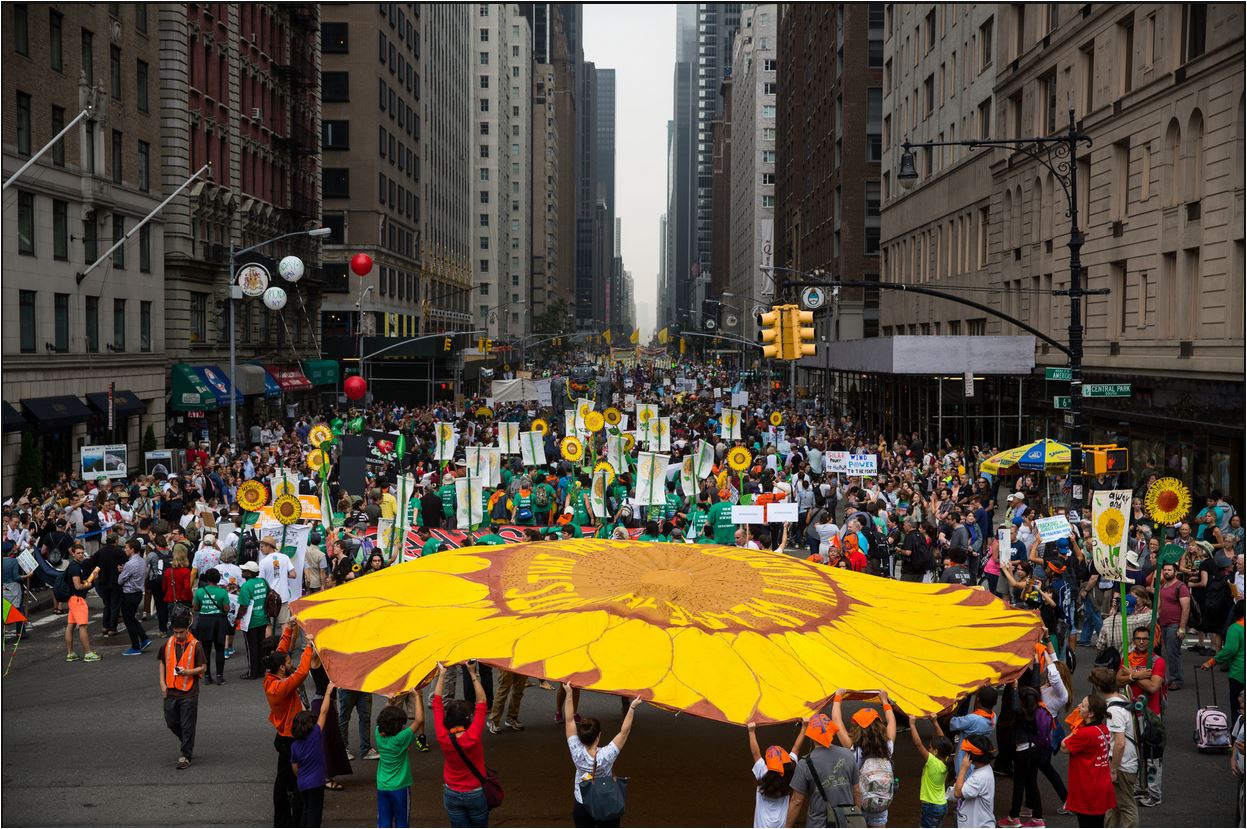
Legions of demonstrators frustrated by international inaction on global warming descended on New York City on Sunday, marching through the heart of Manhattan with a message of alarm for world leaders set to gather this week at the United Nations for a summit meeting on climate change.
Coursing through Midtown, from Columbus Circle to Times Square and the Far West Side, the People’s Climate March was a spectacle even for a city known for doing things big, and it was joined, in solidarity, by demonstrations on Sunday across the globe, from Paris to Papua New Guinea.
“I’m here because I really feel that every major social movement in this country has come when people get together,” said Carol Sutton of Norwalk, Conn., the president of a teachers’ union. “It begins in the streets.”
The march attracted leading lights in the environmental movement, most notably former Vice President Al Gore. It drew the secretary general of the United Nations, Ban Ki-moon, who will preside over this week’s United Nations climate summit meeting. And it included Mayor Bill de Blasio of New York, fresh off his announcement that he was committing the city to an 80 percent reduction in greenhouse gases by 2050.
But it was mostly an event for concerned ordinary people, many of them veterans of climate change efforts, others relative newcomers.
From as close as the Bronx and as far as at least Rome, the demonstrators came in vast numbers. At one point early in the afternoon, the march came to a halt because the entire 2.2-mile route was full, and more than two hours into the procession, people were still setting out from the starting point near Columbus Circle.
Organizers, using data provided by 35 crowd spotters and analyzed by a mathematician from Carnegie Mellon University, estimated that 311,000 people marched the route.The signs that marchers held were as varied as the movement: “There Is No Planet B,” “Forests Not for Sale” and “Jobs, Justice, Clean Energy.”
The diversity of the demonstrators made for some odd juxtapositions. On West 58th Street, the minaret of an inflatable mosque bobbed next to a wooden replica of Noah’s Ark the size of a school bus. Nearby, Capuchin Franciscan monks in flowing brown robes, who were in town from Rome for the march, mingled with nuns, while a group flying a pagan flag beat a drum.
The climax of the march came in the early afternoon. All along the route, crowds had been quieted for a moment of silence. On Avenue of the Americas at 57th Street, there was an eerie silence as marchers raised their arms and looked down.
Then at exactly 1 p.m., a whistle pierced the silence, setting off a minute-long cacophony intended as a collective alarm on climate change. There were the beats of the drums and the blaring of horns, but mostly it was whoops and cries of the marchers.
One of the key organizers of the event, the international advocacy group Avaaz, presented a petition with more than 2.1 million signatures demanding action on climate change. “It’s a testament to how powerful this movement is,” Ricken Patel, executive director of Avaaz, said. “People are coming in amazing numbers.”
Like the march, the summit meeting on Tuesday at the United Nations will be flush with speeches intended to build support for addressing climate change. But the gathering of world leaders is not meant to be a formal negotiating session for a potential 2015 agreement.
Behind the scenes, though, the real work toward forging a global deal was underway. A few blocks from the march, in a hotel conference room on Lexington Avenue, Secretary of State John Kerry convened a meeting of foreign ministers of the 17-member Major Economies Forum, focused on climate change, and Todd Stern, the chief United States climate change negotiator, held back-to-back meetings throughout the day.
Mr. Kerry said he intended to keep a focus on climate change throughout the week, despite the pressure of other crises, including insurgent terrorists in Iraq and the Ebola outbreak in Africa. “The grave threat that climate change poses warrants a prominent position on that list,” he told reporters. “Those are immediate. But this has even greater, longer-term consequences that can cost hundreds of billions, trillions of dollars, and lives, and the security of the world.”
Last week, meteorologists at the National Oceanic and Atmospheric Administration announced that this summer — the months of June, July and August — was the hottest on record for the globe, and that 2014 was on track to break the record for the hottest year, set in 2010.
It was concern about the consequences of that warming that drew people to the march, organized by a dozen environmental, labor and social justice groups, and that inspired some of the event’s most sober and most outrageous expressions, some of them not even on the route.
In front of the Flatiron Building, on Fifth Avenue, a 3,000-pound ice sculpture spelled out “The Future.” Dripping onto the sidewalk, it had been carved over two days in Queens by a group of Japanese ice sculptors. “I would say we are melting down the future,” said Nora Ligorano, one of the artists who conceived the work. “It’s a comment on what we are doing to the planet.”
At Columbus Circle, there were bare-breasted women and people with dreadlocks and homespun clothing. There were Muslim women wearing hijabs and groups of older women with signs proclaiming they were “Grandmas Against Global Warming.” and that “Gray Is Green.”
Two high school seniors from Long Island, Kirsten Cunha and Alexandra Dos Santos, both 17, marched with dust masks over their mouths. “Wearing masks like this could quite possibly be our children’s future,” Ms. Dos Santos said.
AS THE UNITED NATIONS DEBATES THE CLIMATE CRISIS, LARGEST
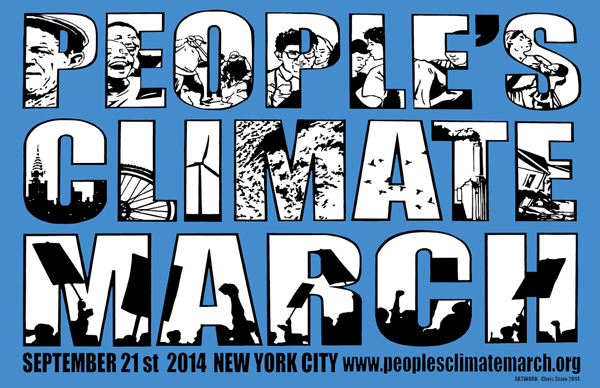
PEOPLE’S CLIMATE MARCH IN U.S. HISTORY IS SET FOR SEPT. 21
NYC IN SOLIDARITY WITH NYC PROTEST, NORTHERN
CALIFORNIA PEOPLE’S CLIMATE RALLY SET FOR SEPT 21
IN OAKLAND!
WHEN: September 21, 2014 @ 2:00 pm – 5:00 pm
WHERE: LAKE MERRITT PARK AMPHITHEATER
Lake Merritt Boulevard Oakland, CA USA
COST: Free
HUNDREDS OF NORTHEN CALIFORNIA ENVIRONMENTAL, SOCIAL
JUSTICE AND TRADE UNION GROUPS TO MOBILIZE IN OAKLAND
As the United Nations prepares to debate how to reduce carbon pollution
and greenhouse gases that pose a dire threat to all humanity, the largest
climate action group in the country, 350.org, headed by Bill McKibben, is
preparing for a historic UN mobilization of environmental activists
across the U.S.
Hundreds of thousands are expected to converge in NYC and thousands
more in many cities including Oakland on September 21st to press
for immediate measures to halt and reverse this catastrophic threat
to humanity and to demand:
A global agreement to dramatically and rapidly reduce global warming
pollution
A world with an economy that works for people and the planet
A world safe from the ravages of climate change
A world with good jobs, clean air & water, peace & justice & a healthy
environment
It’s not too late to prevent dangerous climate change and preserve the planet for future generations, but it may soon be, according to the World Meteorological Organization.
The organization is supporting the Climate Summit convened by U.N. Secretary-General Ban Ki-moon in New York on 23 September with initiatives that underscore the need for international action to tame rapid climate change.
The Summit will serve as a platform for government, finance, business and civil society leaders to announce plans to reduce emissions and mobilize political will for a global agreement in Paris in December 2015 to limit the world to a less than 2-degree Celsius rise in global temperature.
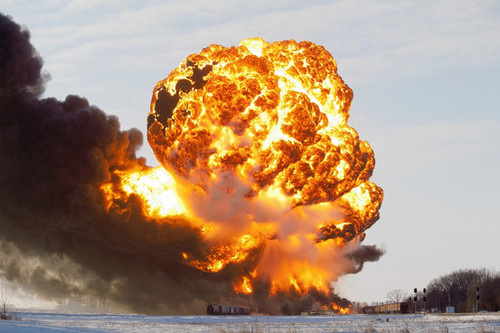
Actually, that’s kind of worrisome, especially considering that if you don’t experience that disaster yourself, your kids probably will. This is one of the many absurd elements showing Valero’s cavalier attitude toward public safety in the draft Environmental Impact Report (EIR) for its proposed crude by rail project, for which public comments were due this week. The hazard analysis in this report is also a serious underestimate, according to the State among many others: The California Public Utilities Commission notes the serious failure of Valero to address the “potential for tragic consequences of crude oil tank car ruptures” from its proposed Crude by Rail Project.
(Casselton, North Dakota, Crude Oil Train Derailment, Dec.30th, 2013)
This dangerous crude project is so riddled with problems that many communities up-rail are now voicing serious concern. The City of Sacramento highlights the high concentration of people around the rail freight lines (“more than 147,000 City residents live within ½ mile”) serving the “Valero Benicia refinery [which] is one of two California refineries that are in the process of securing permits to build rail terminals to import Canadian tar sands and Bakken crude oils.” (emphasis added) And the City of Davis suggests that the “highest levels of protection [be implemented] before disasters such as hazardous material releases and explosions occur [so that] we can avoid having such disasters in the first place.”
We urgently need you to phone bank to voters in San Benito County to get the Yes vote for Measure J to ban fracking:
When: Tuesday, September 23, 2014
6:30pm to 8:30pm
Where: Sierra Club SF Bay Chapter office,
2530 San Pablo Ave, Berkeley Grassroots activists are waging a hard-fought battle to win Measure J to ban fracking in their county. They are faced with oil industry’s millions that have buried voters with TV and radio ads (even on Pandora), mailers, and paid professional canvassers to defeat Measure J. This barrage has confused voters and only one-on-one contact at the door or on the phone can clear up the confusion and get our message out.
Can you join us in phone banking on Sept. 23?
Why you should be concerned: Two years in a row oil industry money killed statewide moratorium bills. Oil money has pressured local elected officials to vote down local ordinances or even reverse their votes after passage. When the governor, our state legislators, and local elected can’t protect us, the last recourse is voters taking matters into their own hands and ban fracking through the ballot measure process. If San Benito wins, it will spark a movement of cities and counties using the ballot initiative to ban fracking. If the oil industry wins, it will be a major setback to the anti-fracking movement in California. We can’t let this happen. With your help we can win Measure J.
If you can join us, please RSVP to ljfoo94546@yahoo.com.
You have been previously informed that the explosive part of the Bakken oil trains problem has a solution. It needs to be “stabilized” before shipping, and the ND Industrial Commission has the power to require the Bakken oil producers to do this.
Why you are not screaming about this from the rooftops to the media, and to the NDIC, I have no idea.
If you don’t believe me, do your own due diligence, and then do your job to protect your citizens.
A refresher:
Years ago, Bakken oil producers made a business decision to not strip all of the NGLs from the crude before shipping, AKA “stabilization.” They deliberately chose not to remove all heptane, pentane, methane, propane, butane, ethane, isobutane and so on, from the crude oil, before filling the tanker cars.
They make more money if they ship it all. That’s why it explodes during derailments.
They neglected to install the proper equipment and build the infrastructure needed to separate, collect, store and distribute the NGLs. Just like they neglected to do the same for the natural gas. That’s why western ND looks like a birthday cake at a retirement home at night.
Bakken oil trains from North Dakota can be rendered NON-explosive before they hit the rails, if they remove the NGLs, but the ND Industrial Commission hasn’t, and won’t, require it (stabilization) of the crude because it would cost the oil companies money.
The governor, who chairs the commission, has had ND emergency agencies practice for 60 deaths, in the event of a derailment/explosion, in Bismarck or Fargo, but refuses to fix the problem at its root.
The taxpayers shouldn’t be footing the bill to prepare for the next Lac-Megantic. This bill belongs to the oil companies.
What will you do to force the ND Industrial Commission to mandate “stabilization” (not “conditioning”) and protect the lives of hundreds of thousands of your citizens that live, work, or play by the tracks?
WASHINGTON D.C. >> Legislation has been introduced to block federal money from going to the twin tunnels under the Sacramento-San Joaquin Delta.
Congressman John Garamendi, D-Fairfield, this week joined Congressmen Jerry McNerney, D-Antioch, and Ami Bera, D-Sacramento, in introducing legislation that would prohibit Fiscal Year 2015 federal funds from being used for California’s Bay Delta Conservation Plan, which includes what Garamendi calls “the twin tunnels boondoggle.”
Gov. Jerry Brown has requested $4 billion from the federal government to help implement the BDCP.
“California’s woefully inadequate water infrastructure definitely needs more federal investment, but the twin tunnels are a boondoggle and poor use of taxpayer dollars. Investments in water conservation, recycling, and storage are needed across the state,” Garamendi said in a press release. “Instead of reigniting the California water war, let’s build consensus and invest in the priorities that create more reliable water for the entire state. We can increase supply without destroying the Delta or undermining water rights
Fossil fuel subsidies have increased by 45% under “All of the Above” energy policy
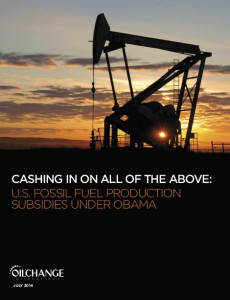
A new report released today by Oil Change International exposes over $21 billion in fossil fuel production subsidies annually in the U.S. at the federal and state levels.
The report, entitled “Cashing in on All of the Above: U.S. Fossil Fuel Production Subsidies under Obama,” outlines the wide array of subsidies going to the industry amidst a deepening climate crisis being spurred by continued fossil fuel extraction and production. In total, the report catalogs over $37 billion in U.S. federal and state support for the fossil fuel industry in 2013.
The report focuses on exploration and production subsidies because these subsidies are tied to the All of the Above energy policy in the U.S., and because they are completely incompatible with climate science that clearly shows that most existing fossil fuel reserves need to be left underground.
Much of the increase in the value of fossil fuel production subsidies in the U.S. can be attributed to the increase in oil and gas production in recent years, the report finds. In particular, federal fossil fuel production and exploration subsidies in the US have grown in value by 45 percent since President Obama took office in 2009.
“While scientists implore world leaders to leave fossil fuels in the ground to avoid a climate catastrophe, our analysis has found that billions upon billions of U.S. taxpayer dollars are going to digging ourselves a bigger climate hole every year,“ said David Turnbull, Campaigns Director of Oil Change International. “Rather than putting down the shovel, our government is using even more taxpayer dollars to buy a backhoe.”
Shakuntala Makhijani, the report’s author and a Researcher at Oil Change International, added, “The science is clear that at least two-thirds of proven fossil fuel reserves need to stay in the ground to avoid catastrophic climate impacts – it is time for the U.S. government to show leadership and immediately end the massive subsidies that encourage their production.”
While the Obama administration has made some attempts to reduce subsidies under its watch, the U.S. Congress, bankrolled by ever-growing campaign contributions from the industry, has completely stymied these efforts. In 2011-12, the industry spent $329 million in campaign finance contributions and received $33 billion in federal subsidies over that same period, marking a 10,000 percent return on investment for the industry.
“The All of the Above energy strategy is not only climate denial – it’s climate denial that is funded with more than $20 billion in taxpayer support each year.” said Steve Kretzmann, Executive Director of Oil Change International. “Until our representatives in Washington and around the country find the courage necessary to put people’s interests ahead of rich polluters, this theft of our tax dollars is likely to continue. The next step for saving the climate should be clear: Stop Funding Fossils.”
The report can be found here: http://bit.ly/2014FFSubsidies
Along with the release of the report, Oil Change International has unveiled a new online hub of resources regarding fossil fuel subsidies on the state, national and international levels. The hub can be found at: http://priceofoil.org/fossil-fuel-subsidies/
As concerns grow over aging rail infrastructure, earthquake readiness and a dramatic increase in crude oil shipments by train, state railroad regulators are scrambling to hire their first-ever railroad bridge inspectors — two of them.
Once they are hired, the California Public Utilities Commission plans to create a state railroad bridge inventory to determine which are most at risk. That’s right — neither the state nor federal government has a list of railroad bridges for California or the rest of the country. Until that happens, the safety of California’s thousands of railroad bridges — key conduits that carry people and hazardous materials over environmentally sensitive ecosystems and near urban areas — is left up to rail line owners and a single federal inspector who splits his time among 11 states.
Trains on the John Muir trestle in Martinez Photo by A. Durfee 2014
“Two more inspectors is better than none, but it’s really a Band-Aid,” said Suma Peesapati, attorney with Earthjustice, an environmental group fighting the oil rail influx. “I think there should be no crude by rail over those bridges until there’s a comprehensive look at all of them.”








 Martinez Environmental Group