Empty crude train derails in North Dakota

http://www.argusmedia.com/News/Article?id=948431

14 Nov 2014

Houston, 14 November (Argus) — BNSF crews worked overnight to clear and repair tracks around Casselton, North Dakota, where 12 empty crude tank cars derailed after being knocked off the tracks by a parallel train that derailed 21 mostly paper and lumber cars.

None of the empty crude cars was compromised, a BNSF spokeswoman said today. There were no injuries, and a broken rail is the suspected cause despite a visual inspection done earlier in the day that indicated no problems.

Casselton was the site of a similar accident on 30 December, when a grain train derailed and caused a full crude train to derail. That accident resulted in the derailment of 21 tank cars, some of which ruptured and caused a massive explosion and fire. There were no injuries in that accident, either.

The December Casselton wreck was one of five fiery crude-by-rail accidents since July 2013, when 47 people died when a runaway crude train crashed in Lac-Megantic, Quebec. The other wrecks have not caused any injuries or deaths.

The spate of accidents have prompted a series of regulator moves, including more inspections, slower speeds and development of stronger tank car requirements in Canada and the US. This week, North Dakota proposed rules to limit the Reid Vapor Pressure (RVP) — a measure of potential volatility — in crude to 13.7 psi starting on 1 February.

“We have to make sure families and communities across North Dakota are safe in their homes and do not live in fear that the next derailment could be in their town,” US senator Heidi Heitkamp (D-North Dakota) said today.

Posted in Uncategorized | Leave a comment

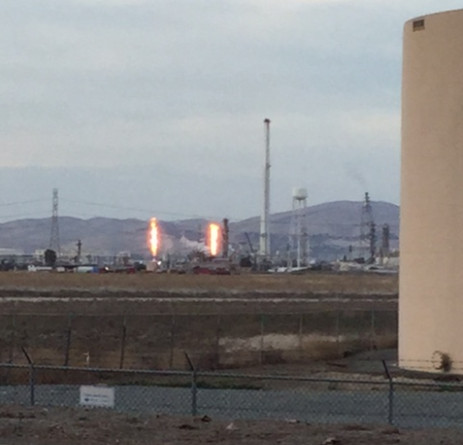
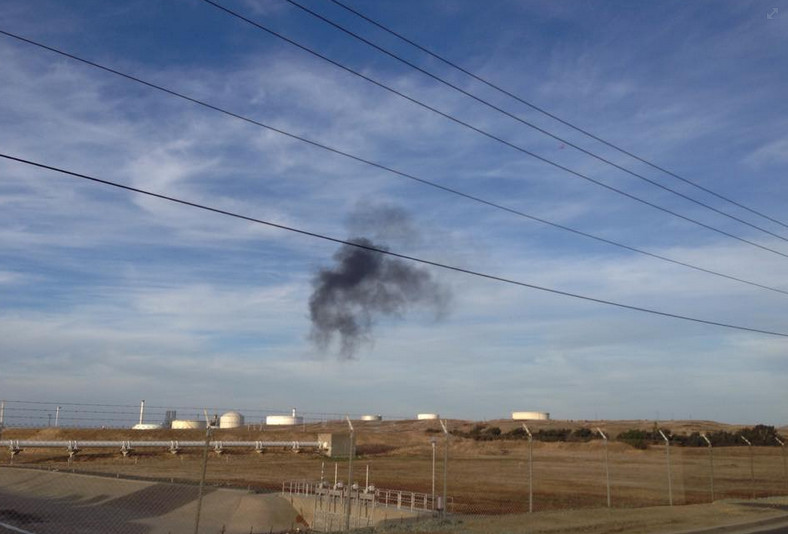
Images of Tesoro “incident” yesterday

flares

Photo by Craig Cannon on claycord.com

black_smoke

Photo by William Lee Walhovd on clayton.com Editor’s Note: After the smoke had dissipated.

Posted in Uncategorized | Leave a comment

Massive Flaring at Tesoro Refinery in Martinez, CA

For at least the second night in a row, flaring at the Tesoro Refinery in Martinez, CA has caused an eerie orange glow to flicker through-out the sky. Video taken by Tom Griffith near the refinery entrance across from the Food Bank just off of Arnold Drive at about 9:30 PM on the way home from dinner. Earlier in the day, another MEG member saw a huge dark black plume of smoke coming from a visible flame in the direction of Tesoro. This flame was visible from about one mile south of the 242 exit going north on I-680 at 4 PM. Another friend reported that the flames were visible from the Alhambra Hills area, where he had never seen them before the last couple of days.
WHAT IS GOING ON AT TESORO?

Posted in Uncategorized | Leave a comment

Tesoro Said to Study Restart of Shuttered Reformer for Chemicals [Editor: Not good news.]

November 05, 2014   Bloomberg News

The Golden Eagle plant near Martinez, California, has been cleaning out the reformer as San Antonio, Texas-based Tesoro decides whether to bring the unit back into service to supply feedstock to chemical plants in markets including Asia, said one of the people, who asked not to be identified because the information isn’t public.

Reformate, traditionally blended by refiners to boost the octane level of gasoline, can also be used as a chemical feedstock because it contains high benzene, toluene and xylene levels.

Tina Barbee, a spokeswoman for Tesoro in San Antonio, declined by e-mail to comment.

Tesoro is considering the return of the Golden Eagle reformer at the same time that it’s developing a $400 million chemical plant at the Anacortes refinery in Washington state to produce mixed xylene for export to Asia. The boost in petrochemical production comes as drillers pull record volumes of oil out of U.S. shale formations that tends to be lighter, yielding more chemicals.

Xylene Plant

Greg Goff, Tesoro’s chief executive officer, said in a call with analysts Oct. 31 that the xylene plant in Washington would be supplied primarily with reformate from the Golden Eagle and Anacortes refineries. The company plans to make a final investment decision on the complex, designed to recover as many as 15,000 barrels a day of mixed xylene, in early 2015 and start service in 2017, he said.

“There’s a huge amount of condensate, a lot of lighter fractions, from shale oil that companies are expecting to drive the cost down for chemicals like xylene,” Jason Miner, a senior chemicals analyst with Bloomberg Intelligence, said by telephone from Princeton, New Jersey.

The global market for xylene, used to make polyester fibers and films for clothing, food packaging and beverage containers, is growing by as much as 7 percent a year, Tesoro said in July.

Contract prices for mixed xylene in South Korea have almost doubled since the fourth quarter of 2008, data compiled by the San Francisco-based energy consulting company Nexant Inc. show. Prices averaged $1,295.50 a metric ton last year, according to Nexant.

To contact the reporter on this story: Lynn Doan in San Francisco at ldoan6@bloomberg.net

To contact the editors responsible for this story: David Marino at dmarino4@bloomberg.net Stephen Cunningham

Posted in Uncategorized | Leave a comment

West Contra Costa wetlands to be restored

By Rick Radin   10/10/2014    Contra Costa Times

NORTH RICHMOND — A neglected parcel of postindustrial wetlands in West Contra Costa will be restored thanks to a water pipeline repair project about 20 miles to the east.

The 3.2-acre tract lies on the southern edge of Rheem Creek between Richmond Parkway and Giant Road in the midst of existing and former industrial uses.

The Contra Costa Water District, which serves central and eastern Contra Costa, is creating wetlands at the site in exchange for the right to disturb wetlands in repairing one of its pipelines near the Tesoro Golden Eagle oil refinery in Pacheco, near Concord.

The pipeline is sometimes used to carry water to the Tesoro refinery and on to Martinez from the Contra Costa Canal, which starts near Knightsen.

It is known as a “shortcut pipeline” that the district uses to bypass a “loop canal” that runs south to Walnut Creek and then north to Martinez, according to water district spokeswoman Jennifer Allen.

Contra Costa Water is putting in some valves that can turn the shortcut pipeline off and on, and building an access road through seasonal wetlands around the pipeline, Allen said.

The district is preparing a proposal on the $2 million wetlands restoration that it will submit to the San Francisco Bay Regional Water Quality Control Board and the Army Corps of Engineers for approval before work can begin.

The restoration will include new plantings, analysis of the wetlands hydrology and a plan for long-term maintenance, Allen said.

Contra Costa Water will contribute $1.2 million to the total cost. The remainder will come from a grant from the California Department of Water Resources administered by the Association of Bay Area Governments, Allen said.

The wetlands are south and west of the larger Breuner Marsh Restoration Project, a wetlands restoration sponsored by the East Bay Regional Park District.Dale Bowyer of the Water Quality Control Board said it is sometimes difficult to find mitigation opportunities close to the site where the wetlands disturbance is taking place.”We always prefer to have mitigation closer to the impact, but that wasn’t possible in this case,” said Bowyer, a senior water resource control engineer. “There was a much smaller site near the pipeline project that wasn’t large enough to be adequate.”

Contra Costa Water draws water through intakes near Bay Point, Knightsen and Victoria Island in the Delta, Allen said.It conveys untreated water through the Contra Costa Canal to treatment plants in eastern and central Contra Costa.

Posted in Uncategorized | Leave a comment

MEG Meeting Schedule for the Holiday Season

ID-100128377

Image courtesy of Dan at FreeDigitalPhotos.net

As the Holiday Season comes upon us, Meg will take a brief hiatus from Community Meetings until January. We will still be busy bees so please feel free to call or email us with your questions, suggestions, and concerns. We will still update the website with pressing issues. A date for the January meeting will be posted soon. Thanks so much for making this a great first year for MEG. We have big plans for 2015!

Posted in Come to Meetings, Featured Events | Leave a comment

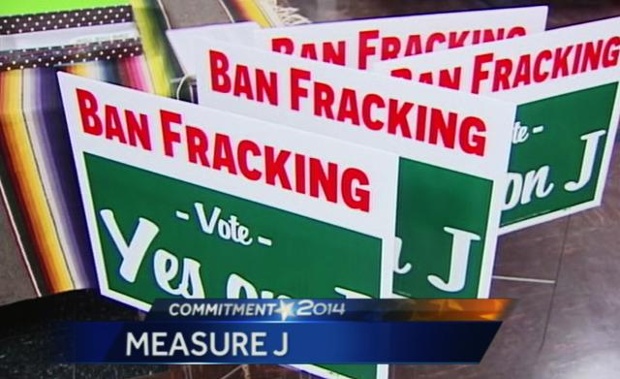
San Benito County voters pass fracking ban with Measure J

http://www.ksbw.com/news/central-california/hollister-gilroy/election-vote-results-san-benito-county/29514894

measure j

HOLLISTER, Calif. —With 100 percent of precincts reporting early Wednesday morning, Measure J passed and made San Benito County the first county in California to pass a fracking ban through voters.

Measure J passed with 5,021 “yes” votes and 3,733 “no” votes, (57.3 percent-42.6 percent).

The Yes On Measure J campaign party turned into a victory party as people cheered and made speeches. Kristen Owenreay said, “We set the bar for the rest of California. We have won a victory for this entire (anti-fracking) movement.”

Posted in Uncategorized | Leave a comment

Voters Reject Oil Titan Chevron, Elect Progressive Bloc in Richmond, California

Tom Butt elected mayor and slate of progressive candidates all win city council seats after grim battle with corporate power

Members of the Asia Pacific Environmental Network march against Chevron in Richmond, Califordia on August 9. (Photo: Malena Mayorga/Flickr)

A slew of progressive candidates were elected in Richmond, California on Tuesday night in a resounding defeat of corporate power, after a multi-million-dollar opposition campaign funded by Chevron brought national attention to the race but failed to take control of City Hall.

Local politician Tom Butt, a Democrat, was elected mayor with 51 percent of the vote, beating the Chevron-backed candidate, Nat Bates, by 16 points. Richmond Progressive Alliance representatives Eduardo Martinez, Jovanka Beckles, and outgoing  Mayor Gayle McLaughlin also won three of the four open seats on the City Council.

Collectively, those candidates became known as Team Richmond.

In a victory speech from his campaign base, Butt said, “I’ve never had such a bunch of people who are dedicated and worked so hard. It’s far away above anything that I’ve ever experienced.”

The sweeping win in the David-and-Goliath story was seen by many as an excoriation of corporate influence in elections after the U.S. Supreme Court’s Citizens United decision.

Uche Uwahemu, who finished third in the mayoral race, said, “The election was a referendum on Chevron and the people obviously made it clear they did not appreciate the unnecessary spending by Chevron so they took it out on the rest of the candidates.”

Chevron spent more than $3 million funding three political action committees that executed an opposition campaign including billboards, flyers, and a mobile screen, spending roughly $72 per voter in hopes of electing a slate of candidates that would be friendly to the oil giant.

Martinez, Beckles, and McLaughlin have all criticized the company and promised to tighten regulations on it. Chevron has an ugly history in the city, particularly in the wake of a large and destructive fire at their refinery in 2012, for which Richmond sued the company.

Butt spent roughly $58,000 on his campaign—a shoestring budget relative to Chevron’s resources.

Posted in Uncategorized | Leave a comment

Effects of climate change ‘irreversible,’ U.N. panel warns in report

By Joby Warrick and Chris Mooney   November 2, 2014   Washington Post

The Earth is locked on an “irreversible” course of climatic disruption from the buildup of greenhouse gases in the atmosphere, and the impacts will only worsen unless nations agree to dramatic cuts in pollution, an international panel of climate scientists warned Sunday.

The planet faces a future of extreme weather, rising sea levels and melting polar ice from soaring levels of carbon dioxide and other gases, the U.N. panel said. Only an unprecedented global effort to slash emissions within a relatively short time period will prevent temperatures from crossing a threshold that scientists say could trigger far more dangerous disruptions, the panel warned.

“Continued emission of greenhouse gases will cause further warming and long-lasting changes in all components of the climate system, increasing the likelihood of severe, pervasive and irreversible impacts,” concluded the report by the United Nations’ Intergovernmental Panel on Climate Change (IPCC), which draws on contributions from thousands of scientists from around the world.

The report said some impacts of climate change will “continue for centuries,” even if all emissions from fossil-fuel burning were to stop. The question facing governments is whether they can act to slow warming to a pace at which humans and natural ecosystems can adapt, or risk “abrupt and irreversible changes” as the atmosphere and oceans absorb ever-greater amounts of thermal energy within a blanket of heat-trapping gases, according to scientists who contributed to the report.
“The window of opportunity for acting in a cost-effective way — or in an effective way — is closing fast,” said Michael Oppenheimer, a Princeton University geosciences professor and contributing author to the report.

The report is the distillation of a five-year effort to assess the latest evidence on climate change and its consequences, from direct atmospheric measurements of carbon dioxide to thousands of peer-reviewed scientific studies. The final document to emerge from the latest of five assessments since 1990, it is intended to provide a scientific grounding for world leaders who will attempt to negotiate an international climate treaty in Paris late next year.

While the IPCC is barred from endorsing policy, the report lays out possible scenarios and warns that the choices will grow increasingly dire if carbon emissions continue on their current record-breaking trajectory.

“It’s not too late, but the longer you wait, the more expensive it gets,” Gary Yohe, a Wesleyan University professor who also participated in the drafting of the report, said in an interview. Damage to the Earth’s ecosystems is “irreversible to the extent to which we have committed ourselves, but we will commit ourselves to higher and higher and higher damages and impacts” if the world’s leaders fail to act, Yohe said.

A succession of IPCC reports since the 1990s have drawn an ever-clearer connection between human activity and climate change. But Sunday’s “synthesis report” makes the case more emphatically than before, asserting that the warming trend seen on land and in the oceans since the 1950s is “unequivocal” and that it is “extremely likely” — a term that the IPCC uses to denote a 95 percent or greater probability — that humans are the main cause.
“Human influence on the climate system is clear,” the panel states in a 40-page summary intended for policymakers.

In late 2013, when the first report of this round of the IPCC’s work came out, skeptics trained their attention on the contention that in recent years the rate of global warming has seemingly “paused” or slowed down. But the latest document is fairly dismissive of that idea, acknowledging that, while the rate of warming in the past 15 years has indeed been somewhat smaller than the rate since 1951, “trends based on short records are very sensitive to the beginning and end dates and do not in general reflect long-term climate trends.”

Although it is too early to say, claims about a possible slowing of global warming may be swept aside by new data: According to the National Oceanic and Atmospheric Administration, all-time monthly temperature records were broken four times in 2014 — in May, June, August and September — raising the possibility that 2014 may set a record as the hottest year ever.

In cautious and often technically complex language, the new report cites soaring emissions of carbon dioxide, methane and other greenhouse gases in the past 60 years as the cause of nearly all the warming seen so far. While carbon dioxide is a naturally abundant gas essential for plant photosynthesis, it has been accumulating in the atmosphere at an unprecedented rate as a byproduct of the burning of fossil fuels by automobiles, power plants and factories. Concentrations of the heat-trapping gas is 40 percent higher than in pre-industrial times, a level “unprecedented in at least the last 800,000 years,” the report states.
Most of the excess heat is absorbed by the ocean, muting the effects. Yet, climate change is having profound impacts on “natural and human systems on all continents and across the oceans,” the panel concluded. It cited rising sea levels, more extreme weather events, warmer air and ocean temperatures, melting glaciers and vanishing sea ice.

And because of the long amount of time that carbon dioxide remains in the atmosphere, some impacts are locked in, perhaps for centuries to come, the report warned.

“A large fraction of anthropogenic climate change . . . is irreversible on a multi-century to millennial time scale,” the report said. Sea level rise, for example, “will continue for many centuries beyond 2100” because of ice-sheet melting that is underway and other causes.

Scientists and policymakers have set a goal of restraining the average global temperature increase to no more than 2 degrees Celsius, or 3.6 degrees Fahrenheit, on grounds that a higher increase would change the climate so dramatically that neither humans nor natural ecosystems could easily adapt. That would probably require keeping concentrations of key greenhouse gases in the atmosphere to under 450 parts per million by 2100, the panel said. Concentrations passed 400 parts per million for the first time in 2013.

Even with a rapid shift to renewable energy, the task of achieving such drastic reductions is daunting, IPCC Chairman Rajendra Pachauri said in a speech last week as panel members began final revisions to the report.
“May I humbly suggest that policymakers avoid being overcome by the seeming hopelessness of addressing climate change,” Pachauri said. “It is not hopeless. This is not to say it will be easy.”

The report will likely add fuel to the debate over environmental policies in key congressional races. Candidates in several Senate and House races have clashed over how to respond to climate change and whether it indeed exists.

Secretary of State John F. Kerry, reacting to the report, said it was time to move beyond the politicization of climate science.

“We can’t prevent a large scale disaster if we don’t heed this kind of hard science,” Kerry said in a statement. “The longer we are stuck in a debate over ideology and politics, the more the costs of inaction grow and grow. Those who choose to ignore or dispute the science so clearly laid out in this report do so at great risk for all of us and for our kids and grandkids.”

Chris Mooney reports on science and the environment.

Posted in Uncategorized | Leave a comment

How Long Can The Shale Revolution Last? [Editor’s note: Apparently, not very long!]

By Nick Cunningham   Wed, 29 October 2014

A new study has cast serious doubt on whether the much-ballyhooed U.S. shale oil and gas revolution has long-term staying power.

The U.S. produced 8.5 million barrels of oil per day in July of this year — 60 percent more than just three years earlier. That is also the highest rate of production in three decades.

Put another way, since 2011, the U.S. has added 3 million barrels per day in additional capacity to global supplies. Had that volume not come online, oil prices would surely be much higher than they currently are.

That has “revolutionized” the energy industry and geopolitics, as scores of energy analysts have claimed. The Energy Information Administration (EIA) forecasts that U.S. oil production will hit 9.6 million barrels per day (bpd) in 2019, and gradually decline to 7.5 million bpd by 2040.

Related: Low Oil Prices Hurting U.S. Shale Operations

This would allow the U.S. to be one of the world’s top oil producers for an extended period of time. With such an achievement now at hand, many analysts are predicting an era of American dominance in geopolitics. For example, in an op-ed on Oct. 20, columnist Joe Nocera considered a “world without OPEC,” in which U.S. oil production soon kills off the oil cartel.

Or consider this rather triumphalist piece in Foreign Affairs from earlier this year, where two former National Security Council members who worked under President George W. Bush boasted that the recent surge in oil production “should help put to rest declinist thinking” and “sharpen the instruments of U.S. statecraft.” In the following issue, Ed Morse of Citibank went further. “Despite its doubters and haters, the shale revolution in oil and gas production is here to stay,” he declared.

But a new report throws cold water on the thinking that U.S. shale production will be around for the long haul. The Post Carbon Institute conducted an analysis of the top seven oil and top seven natural gas plays, which together account for 89 percent of current shale oil production and 88 percent of shale gas production.

The report found that both shale oil and shale gas production will peak before 2020. More importantly, the report’s author, David Hughes, says oil production will decline much more quickly than the EIA has predicted.

That’s largely because of high decline rates at shale wells across the country. Unlike conventional wells, which can produce relatively stable rates for a long period of time, shale oil and gas wells experience an initial burst of production in the first few years, followed by a precipitous decline thereafter.

Hughes estimates that the average shale oil well declines at a rate of between 60 and 91 percent over three years. Wells in the Bakken decline by 45 percent per year, which stands in stark contrast to the 5 percent annual decline for an average conventional well.

Or put another way, oil and gas companies will have to keep drilling at a feverish pace just to stand still. This means the industry is on a “drilling treadmill” that will be unsustainable over the long-term.

Predicting what oil production will be in 25 years is difficult, to say the least, but the Post Carbon report projects that oil production from the Bakken and Eagle Ford will be just one-tenth of the level that EIA is forecasting. The EIA predicts that the Bakken and the Eagle Ford will be producing a combined 1 million bpd in 2040. Hughes thinks it will be just a small fraction of that amount – a mere 73,000 bpd.

Related: OPEC & Russia’s Vulnerability and America’s Ingenuity

This is not the first time that David Hughes has taken aim at EIA data. In a December 2013 report, he skewered the high estimates for the potential of the Monterrey Shale in California, calling the EIA’s numbers “simplistic and highly overstated.” Several months later, the EIA was forced to back track on its figures, downgrading the recoverable oil estimates in the Monterrey by 96 percent.

Hughes says the implications of getting it wrong are “profound,” since so many companies are basing very large investments on incorrect projections. He says rosy estimates have cut into investment for renewables, while steering capital towards expensive oil and gas export terminals that should now be called into question.

An article in CleanTechnica points to the possibility of boom towns turning into “ghost towns” if the pace of drilling drops off. If David Hughes and The Post Carbon Institute are correct, there could be quite a few ghost towns popping up in the coming years as the shale revolution begins to fizzle.

By Nick Cunningham of Oilprice.com

Posted in Uncategorized | Leave a comment