CoCo County Greenlights ‘Tar-Sands-By Rail Project’

By Jean Tepperman     FEBRUARY 5, 2015      Easy Bay Express

The Phillips 66 refinery in Rodeo won approval for a major new project from the Contra Costa County Board of Supervisors this week, despite the objections of refinery neighbors and environmental groups. The two sides painted very different pictures of the proposal. According to Phillips 66, the project will lower the emissions of air pollution and greenhouse gases while providing more jobs. According to opponents, it will produce more air pollution, increase hazards and greenhouse gas emissions, and lead to tar sands oil traveling on trains through the Bay Area.

Phillips 66 plans to build new tanks to store propane and butane gas, byproducts of the refining process. Currently, the refinery uses these materials to power its operations. When the project is completed, Phillips 66 will sell the propane and butane, buying cheaper natural gas to power the plant.

Phillips 66 public affairs manager Paul Adler told the supervisors that “the new equipment will cut sulfur emissions by half,” and thus “lead to cleaner air.” Shipping the propane and butane out by rail will not change the number of trains leaving the refinery, although it will add cars, he said. The project “won’t change the volume or type of crude oil processed by the refinery,” Adler added. “This is not a crude-by-rail project.”

“This is a tar-sands-by-rail project,” countered Roger Lin, attorney for Communities for a Better Environment. CBE previously submitted a technical analysis concluding that the goals of the project could not be achieved without a switch to dirtier, heavier crude oil. CBE also quoted Phillips 66 CEO Greg Garland announcing the company’s intention to increase profits by refining cheaper crude oil, specifically mentioning “Canadian crude.” (Tar sands crude is the cheapest around.)

CBE predicts that the project in Rodeo, together with a linked project in the Phillips 66 refinery in Santa Maria (San Luis Obispo County), will mean that tar sands crude oil will travel by train from Canada to San Luis Obispo, on tracks that run through East Bay cities. It will be partially refined in San Luis Obispo County, then sent via pipeline to the Rodeo plant to complete the refining process.

Lin said Tuesday that the final environmental impact review of the project presents no new data to counter CBE’s analysis, simply restating Phillips’ declaration that the project will not change the type of crude oil the plant refines.

When the project first came up for approval, supervisors asked for a revised environmental impact review to address concerns raised by community groups and by the Bay Area Air Quality Management District. The air district was especially concerned about the “cumulative health impacts” of adding this project to others in the area. In this week’s hearing, Tim Rimpo of Environmental Science Associates, a member of the county’s environmental review team, said the county had worked closely with the air district. Although they found the project would increase emissions of some toxic air pollutants, they agreed that “all the impacts would be less than the air district’s significance thresholds.”

Posted in Uncategorized | Leave a comment

Watch this video about our Bay Area Refinery Corridor!

Click here for a great video about the

Bay Area California Refinery Corridor.

Capture

This video was put together by Sophie and Clement Guerra. They are two documentary filmmakers also in the process of making a full-length documentary called:
The Condor and the Eagle.
Here’s a link to their website – The Take-off


Posted in Uncategorized | Leave a comment

Iowa train derailment leads to ethanol leaking into Mississippi River

http://www.cbsnews.com/news/iowa-train-derailment-leads-to-ethanol-leaking-into-mississippi-river/

by Associated Press   Feb. 5, 2015

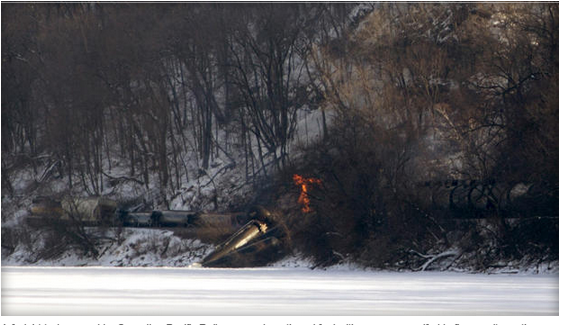
A freight train owned by Canadian Pacific Railway carrying ethanol fuel with one car engulfed in flames sits on the banks of the Mississippi River in a remote location north of Dubuque, Iowa, Feb. 4, 2015, in this picture provided by the Dubuque Telegraph Herald.  MIKE BURLEY/DUBUQUE TELEGRAPH HERALD/HANDOUT VIA REUTERS

A freight train owned by Canadian Pacific Railway carrying ethanol fuel with one car engulfed in flames sits on the banks of the Mississippi River in a remote location north of Dubuque, Iowa, Feb. 4, 2015, in this picture provided by the Dubuque Telegraph Herald. MIKE BURLEY/DUBUQUE TELEGRAPH HERALD/HANDOUT VIA REUTERS

DES MOINES, Iowa — Railroad officials said Thursday it’s unclear how much ethanol has leaked into the Mississippi River from a train that derailed a day earlier in eastern Iowa, but that they were working to monitor the environmental impact and offload fuel from the train.

The cars went off the tracks Wednesday morning in a remote area about 10 miles north of Dubuque. Canadian Pacific spokesman Jeremy Berry said 14 derailed cars were carrying ethanol, and eight of them appeared to be leaking.

“We have verified some ethanol has reached the water but we do not have an estimate of how much,” said company spokesman Andy Cummings, who was at the scene Thursday morning.

Federal and state environmental agencies are working with the company to set up ethanol monitoring sites downriver. Unlike oil, which floats on water, ethanol mixes with water and dilutes as it gets further from the spill site, which can deplete the oxygen in water in high concentrations and kill fish, said Iowa Department of Natural Resources spokesman Kevin Baskins.

Local authorities said three cars caught fire and three others plunged into the river. The fires had been extinguished by Thursday morning, and no injuries have been were reported. The 81-car train was heading east on CP tracks.

The derailment occurred in an area inaccessible by road, forcing crews to build a temporary access road to get equipment to the tracks. Cummings said officers were planning to get in a boat to assess the spill from the water, but that frozen sections and ice in the river could be an issue.

Baskins said his department notified the cities of Davenport, Burlington and Keokuk, which are downriver and use the Mississippi River as a drinking water source, as a precaution.

“Our efforts are focused on safety above all else. We will begin the process of transferring product from the derailed cars to empty cars at the site and safely remove derailed cars,” Cummings said.

Posted in Uncategorized | Leave a comment

Western States Petroleum Association topped lobby list with $8.9 million spent in 2014

by Dan Bacher    Feb 04, 2015   Daily Kos

http://m.dailykos.com/story/2015/02/04/1362254/-Petroleum-Association-topped-lobby-list-with-8-9-million-spent-in-2014

The oil industry continued its long reign as the top spender on lobbying in California in 2014, according to data just released by the California Secretary of State.

The Western States Petroleum Association (WSPA) topped the list with $8.9 million spent on lobbying in 2014, nearly double what it spent in the previous year.

WSPA spent much of its money on stopping a fracking moratorium bill in the Legislature and trying to undermine California’s law to lower greenhouse gas emissions to 1990 levels by 2020.

Cahterine Reheis-Boyd, President of WSPA and the former Chair of the Marine Life Protection Act (MLPA) Initiative Blue Ribbon Task Force to create questionable “marine protected areas” in Southern California, also successfully opposed legislation by Senator Hannah-Beth Jackson to protect the Vandenberg State Marine Reserve and the Tranquillon Ridge from offshore oil drilling plan.

“The winners of the 2014 lobbying competition are in – and the winner is… BIG OIL!’ said Stop Fooling California, an online and social media public education and awareness campaign that highlights oil companies’ efforts to mislead and confuse Californians. “Congratulations, Western States Petroleum Association and Chevron! No one has spent more on evil in California than you!”

The association spent a total of $4,009,177.87 lobbying state officials in the third quarter of 2014, a new quarterly record by WSPA.

During that quarter, the association paid $375,800.53 to KP Public Affairs, a prominent Sacramento lobbying and public relations firm that represents clients in health care, aerospace manufacturing and other industries. WSPA also paid $77,576.50 to Pillsbury Winthrup Shaw Pittman LLP.

WSPA spent $1,456,785.24 in the first quarter, $1,725,180.34 in the second quarter and $1,692,391.52 in the fourth quarter of 2014.

Along with KP Public Affairs and Pillsbury Winthrup Shaw Pittman LLP, the association hired Alcanltar & Kahl, LLP, and California Resource Strategies to lobby for Big Oil.

The oil industry is the most powerful corporate lobby in California, greatly overshadowing corporate agribusiness, the high tech industry, the movie industry and other special interests in the money and influence that it wields in state politics.

The oil industry has spent over $70 million on lobbyists in California since January 2009, according to a recent report written by Will Barrett, the Senior Policy Analyst for the American Lung Association in California. (http://www.lung.org/…)

The Western States Petroleum Association (WSPA) topped the oil industry spending with a total of $31,179,039 spent on lobbying since January 1, 2009 at the time of Barrett’s report. Chevron was second in lobbying expenses with a total of $15,542,565 spent during the same period.

From July 1 to September 30 alone, the oil industry spent an unprecedented $7.1 million lobbying elected officials in California “with a major focus on getting oil companies out of a major clean air regulation,” said Barrett.

Big Oil also spent many millions of dollars in the November 2014 election, including Chevron spending $3 million (unsuccessfully) to elect “their” candidates to the Richmond City Council.

In addition, Big Oil dumped $7.6 million into defeating a measure calling for a fracking ban in Santa Barbara County and nearly $2 million into an unsuccessful campaign to defeat a measure banning fracking and other extreme oil extraction techniques in San Benito County.

Not only does Big Oil spend millions every year on lobbying and campaign contributions, but it funds “Astroturf” campaigns to eviscerate environmental laws. Leaked documents provided to Northwest Public Radio, Business Week and other media outlets last year exposed a campaign by the Western States Petroleum Association to fund and coordinate a network of “Astroturf” groups to oppose environmental laws and local campaigns against fracking in California, Washington and Oregon.

This network was revealed in a PowerPoint presentation from a Nov. 11 presentation to the Washington Research Council, given by Catherine Reheis-Boyd, WSPA President. (https://www.indybay.org/…)

“The Powerpoint deck details a plan to throttle AB 32 (also known as the California Global Warming Solutions Act of 2006) and steps to thwart low carbon fuel standards (known as LCFS) in California, Oregon, and Washington State,” revealed Stop Fooling California. (http://www.stopfoolingca.org/…)

Oil and chemical industry representatives also further exert their power and influence by serving on state and federal regulatory panels. In one of the most overt conflicts of interest in recent California history, WSPA President Catherine Reheis-Boyd served as the Chair of the Marine Life Protection Act Blue Ribbon Task Force to create fake “marine protected areas” in Southern California. She also served on the task forces for the Central Coast, North Central Coast and North Coast.

These so-called “marine protected areas” fail to protect the ocean from fracking, offshore oil drilling, pollution, military testing, corporate aquaculture and all human impacts on the ocean other than fishing and gathering.

Not only did these so-called “Yosemites of the Sea” fail to protect the ocean, but they violate the traditional fishing and gathering rights of the Yurok Tribe and other Indian Nations and are based on terminally flawed and incomplete science. In fact, Ron LeValley, the Co-Chair of the MLPA Initiative Science Advisory Team for the North Coast, is currently in federal prison for conspiracy to embezzle $852,000 from the Yurok Tribe.

The millions Chevron and other oil companies have spent on lobbying, campaign contributions and setting up “Astroturf” groups promoting the oil industry agenda are just chump change to Big Oil. The five big oil companies – BP, Chevron, Conoco-Phillips, Exxon Mobil and Shell – made a combined total of $93 billion in 2013.

Posted in Uncategorized | Leave a comment

Labor Network for Sustainability Calls for Support for Oil Strikers

http://www.labor4sustainability.org/articles/labor-network-for-sustainability-calls-for-support-for-oil-strikers/

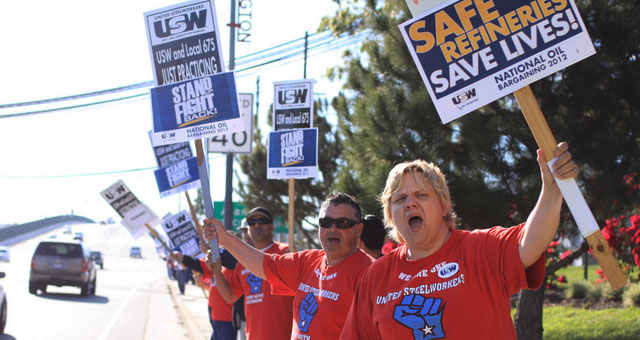
TesoroProtest

The Labor Network for Sustainability today called for environmentalists and other allies of organized labor to support oil refinery workers who went on strike this week.

Joe Uehlein, Executive Director of LNS, said, “Oil refinery workers are in the front line of protecting our communities against the environmental hazards of the oil industry. Their skill and experience is critical for preventing devastating explosions, spills, and releases. The oil companies are creating conditions that make it impossible for refinery workers to protect us. Their strike is about making conditions that are safe and healthy for workers and communities. They deserve the support of environmentalists and everyone concerned about the rights and wellbeing of working people.”

Oil producers have slashed spending because of the falling price of oil. The result has been devastating for workers on the job. According to Steelworkers International Vice-President Gary Beevers, head of the Steelworkers National Oil Bargaining Program, “This work stoppage is about onerous overtime; unsafe staffing levels; dangerous conditions the industry continues to ignore; the daily occurrences of fires, emissions, leaks and explosions that threaten local communities without the industry doing much about it; the industry’s refusal to make opportunities for workers in the trade crafts; the flagrant contracting out that impacts health and safety on the job; and the erosion of our workplace, where qualified and experienced union workers are replaced by contractors when they leave or retire,” Beevers added.

That does not mean that oil companies lack the money to provide safe and decent working conditions. Refiners’ shares on the Standard & Poor’s 500 have more than doubled since the beginning of 2012. According to LNS Executive Director Uehlein, “It is critical that environmentalists support the rights and needs of working people, just as it is essential that workers support the need for a clean, healthy environment. As we work to protect the earth from climate change, it is particularly important that we advocate for the needs of workers in fossil fuel industries whose wellbeing must not be sacrificed to the necessity to reduce greenhouse gas emissions.”

The Labor Network for Sustainability (www.labor4sustainability.org) is dedicated to engaging trade unionists, workers, and their allies to support economic, social, and environmental sustainability.

Contact: Joe Uehlein, Labor Network for Sustainability: joeuehlein@mac.com

Posted in Uncategorized | Leave a comment

TONY MAZZOCCHI’S SPIRIT HAUNTS BIG OIL AGAIN

by Steve Early    February 4, 2015     beyondchron.org

Twelve years ago, America’s leading advocate of occupational health and environmental safety succumbed to pancreatic cancer.

In the U.S., where the influence of organized labor has long been contracting, the death of a former trade union official is often little noted. Yet Tony Mazzocchi was no ordinary labor leader. His passing from the scene, at age 76, was widely recognized and correctly mourned as a great loss for the entire union movement.

As a top strategist for the Oil, Chemical and Atomic Workers (OCAW), Mazzocchi pioneered alliances between workers concerned about job safety and health hazards and communities exposed to industrial pollution generated by companies like Shell, Chevron, and Mobil.

In 1973, members of the OCAW (who are now part of the United Steel Workers) conducted a national contract campaign and four-month strike at Shell Oil over workplace safety rights and protections. As Mazzocchi’s biographer, Les Leopold notes, “the strike helped build a stronger anti-corporate movement” because OCAW members learned “that you can’t win these fights alone.” To win—or even just battle Big Oil to a draw—workers had to join forces with the very same environmental organizations long demonized by the industry as the enemy of labor and management alike.

Striking Big Oil Again

Four decades later, echoes of that struggle could be heard on the refinery town picket-lines that went up in northern California, Texas, Kentucky, and Washington state this week. Thousands of oil workers walked out, for the first time in 35 years, over issues and demands that Tony Mazzocchi helped publicize and build coalitions around for much of his career.

About 30,000 refinery employees are still covered by the USW agreement that expired last weekend. Nearly 4,000 of them are on strike at nine plants already, including Tesoro refineries in Martinez and Carson, CA. Other USW members, including those employed at Chevron in Richmond, may join the walkout if industry negotiators fail to address non-wage issues summarized by USWA vice-president Gary Beevers as follows:

“Onerous overtime, unsafe staffing levels, dangerous conditions the industry continues to ignore; the daily occurrences of fires, emissions, leaks and explosions that threaten local communities without the industry doing much about it and the flagrant contracting out that impacts health and safety on the job.”

In the best Mazzocchi tradition, that list of union concerns will certainly resonate among my Richmond neighbors, who saw Chevron’s huge refinery here erupt in a major explosion and fire several years ago and often complain about the bad air quality resulting from its emissions.

Unfortunately, too many people in this community equate Chevron’s unionized workforce with the AFL-CIO building trades organizations that regularly mobilize their members to support the company’s own questionable environmental agenda. Just last fall, those unions, which represent workers employed by Chevron contractors, joined Chevron in a  $3.1 million campaign to defeat progressive candidates for Richmond city council and mayor. All of these outspoken critics of the company’s workplace safety and environmental record were elected or re-elected anyway, after a strong grassroots campaign by the Richmond Progressive Alliance (RPA).

CSB Findings Validate The Union

As recently as January 28, the U.S. Chemical Safety Board was back in our city hall chambers releasing its final findings and recommendations on Chevron’s 2012 refinery accident.  The CSB again faulted lax maintenance practices for “ the catastrophic pipe rupture,” hydrocarbon release, and resulting vapor cloud that engulfed nineteen employees, nearly killing them.  Fall-out from the accompanying forced 15,000 residents of Richmond and neighboring communities to seek medical attention; the city is now suing Chevron for millions of dollars in compensation for other losses, including damage to local property values.

In its final report, the CSB criticized a Chevron “safety culture” that “encouraged continued operation of a unit despite hazardous leaks” and discouraged its unionized employees from asserting their contract safety rights. The CSB’s lead investigator, Don Holmstrom, cited evidence of “increased reluctance” among Chevron refinery operators “to use their ‘stop work’ authority despite being concerned about the results of maintenance deficiencies.”

On January 28, the company’s usual building trades cheering squad was conspicuously absent. Instead, members of USWA Local 5 turned out in force, wearing union jackets and holding signs publicizing their key bargaining demands, which overlap with the CSB’s own recommendations and proposals (none of which are binding on Chevron).

Local 5 member Jim Payne applauded the CSB and welcomed its backing for stronger “stop work” authority in situations of imminent danger.  Former Richmond mayor and now city council member Gayle McLaughlin backed Local 5 all the way. “I support the calls for workers’ right to shut down operations when they feel it’s unsafe,” she told the CSB on Jan. 28–just three months after Chevron and its building trades allies failed, once again, to drive her from office.

Divide and Conquer No More?

In a message to USW members and community supporters this week, Local 5 president BK White sounded like an RPA member himself. “Chevron for years has attempted to rule the Richmond refinery through fear mongering,” he asserted. The city’s “progressive element…has been painted in a bad light for their work of attempting to fight for local residents.”

“The company has attempted to quell the voices of workers with the fear of the refinery’s closing, whether it is from regulatory agencies or community activists, “White said. “This is a failed attempt to weaken the union and intimidate our rank-and-file from rocking the boat or fighting for their rights…To underestimate our resolve, would be a grave miscalculation.”

Union-oriented environmental activists, locally and nationally, are responding in kind. The Labor Network for Sustainability is calling for USWA picket line support and other forms of solidarity. (See http://www.labor4sustainability.org)

Like Tony Mazzocchi long ago, its national coordinator, Joe Uehlein stresses the importance of linking up with refinery workers because they “are on the frontlines of protecting our communities against the environmental hazards of the oil industry.” According to Uehlein, management is “creating conditions that make it impossible for refinery workers to protect us,” even though their shop-floor “skill and experience is critical for preventing devastating explosions, spills, and releases.”

As part of its own outreach to community allies, the USW is making the case for oil industry safety reform in a compelling video entitled Still Out of Control. (See http://www.usw.org/video/still-out-of-control). The problems of understaffing, mandatory overtime, worker fatigue, lack of refinery maintenance, and too much contracting out are all well-documented in this short film, a sequel to one made by the OCAW years ago.

There are many other industries in America that put production and profits before safety but few with deeper pockets or greater environmental impact than Big Oil. So what better place to make blue-green alliance building more real than rhetorical, among labor and community partners long pitted against each other by companies like Chevron and Shell?

(Steve Early was a national union representative for 27 years. He lives in the refinery town of Richmond, California and is currently writing a book about that city’s history, politics, labor and environmental struggles. He is the author, most recently, of Save Our Unions: Dispatches from a Movement in Distress. He can be reached at Lsupport@aol.com)


Posted in Uncategorized | Leave a comment

County supervisors approve Rodeo refinery’s propane and butane recovery project

By Tom Lochner    2/4/15   Oakland Tribune

http://www.contracostatimes.com/breaking-news/ci_27452207/martinez-supervisors-approve-rodeo-refinerys-propane-and-butane

Andres Soto, holding papers, of Communities for a Better Environment, and others stand at the Contra Costa County Board of Supervisors meeting in Martinez, Calif., on Tuesday, Feb. 3, 2015. Opponents and proponents of a propane and butane recovery project at the Phillips 66 refinery in Rodeo made their feelings known as the board ponders an appeal of a land use permit for the project and considers the Environmental Impact Report as well. (Dan Honda/Bay Area News Group)

Andres Soto, holding papers, of Communities for a Better Environment, and others stand at the Contra Costa County Board of Supervisors meeting in Martinez, Calif., on Tuesday, Feb. 3, 2015. Opponents and proponents of a propane and butane recovery project at the Phillips 66 refinery in Rodeo made their feelings known as the board ponders an appeal of a land use permit for the project and considers the Environmental Impact Report as well. (Dan Honda/Bay Area News Group)

MARTINEZ — A propane and butane recovery project at the Phillips 66 petroleum refinery in Rodeo won approval Tuesday from the Contra Costa Board of Supervisors after more than a year of wrangling over the project’s scope, its impacts on health and the environment, and safety concerns.

The 4-1 decision, with board chairman John Gioia dissenting, “will help ensure the long-term viability of the Rodeo Refinery and the many jobs it provides,” Paul Adler, the new spokesman for the refinery, said after the vote.

“Protecting our people, our environment, and our communities guides everything we do,” added Adler, who previously worked for the county as a district representative for Supervisor Federal Glover.

But opponents, including the environmental advocacy group Communities for a Better Environment, vowed to continue the fight.

“This is an example of environmental injustice,” said Roger Lin, attorney for CBE, adding that “procedural and substantive errors” accompanied the board’s decision.

The group contends that the Rodeo project should be considered as one with a crude-by-rail project at another Phillips 66 refinery in San Luis Obispo County, currently under that county’s review.

That project calls for crude oil to be transported by rail, possibly along the shores of San Pablo and San Francisco bays, to the Phillips 66 Santa Maria refinery, where crude oil is partially refined and sent on to the Rodeo refinery via a 200-mile pipeline.

The Rodeo project calls for installation of new equipment to recover and sell propane and butane instead of burning it as fuel at the refinery or flaring off excesses. Phillips 66 maintains that the project would reduce emissions of several pollutants, including sulfur dioxide, partly by using cleaner-burning natural gas as refinery fuel and because sulfur would be extracted in preparation of butane and propane for sale.

The new equipment would include a hydrotreater, six storage vessels and two new rail spurs related to shipping the recovered propane and butane out of the refinery in tank cars.

The county Planning Commission granted the refinery a land use permit in November 2013; Commissioner Rand Swenson, a former Phillips 66 Rodeo refinery manager, was absent.

CBE and the law firm of Shute, Mihaly & Weinberger, representing the Rodeo Citizens Association, appealed the Planning Commission decision and contested the initial Environmental Impact Report, saying it understated potential consequences of the project and warning that Phillips planned to process more and dirtier crude oil.

Phillips 66, in a Jan. 14 letter to the board, characterized the opponents’ assertions as “speculative, erroneous and false” adding that the size of the project is based on the existing volume of refinery fuel gas derived from the existing crude oil it processes.

Greg Karras, senior scientist for CBE, said after the meeting that Phillips 66 “doctored the science” by using future volumes of propane and butane as a baseline rather than basing it on existing conditions.

Lin declined to say what steps CBE will take to continue the fight.

Tuesday’s vote came after the matter was agendized and postponed several times over the past year.

Gioia voted no after other board members balked at including a condition of approval he proposed that reiterated some points of the county’s Industrial Safety Ordinance and assured that at the moment of construction, Phillips 66 will use the most advanced and safest technology, and that county health officials first must approve it.

In a recent example of regulatory guidelines known as Inherently Safer Systems, the U.S. Chemical Safety Board recommended that Chevron use more corrosion-resistant pipe at its Richmond refinery to replace piping that failed in August 2012, leading to a fire that sickened thousands, Gioia noted.

In rejecting the appeals and approving a Recirculated Environmental Impact Report, the board also adopted a condition of approval that includes a Community Benefits Package worth $4.2 million for improvements in the Crockett-Rodeo area in Glover’s District 5.

Contact Tom Lochner at 510-262-2760. Follow him at Twitter.com/tomlochner.

Posted in Uncategorized | Leave a comment

Martinez: Tesoro refinery among nine plants where strikes planned

By Rick Hurd   02/02/2015    bayareanewsgroup.com

http://www.mercurynews.com/business/ci_27441751/from-texas-california-union-asks-refinery-workers-strike

MARTINEZ — Workers at the Tesoro refinery near Martinez were preparing to strike Monday, after the United Steelworkers union called for members at nine of its plants Sunday to stage their first walkout in more than 30 years.

The strike, the first by the USW since 1980, was set after the union said negotiations with Shell Oil Co. broke down after talks for a new bargaining contract started Jan. 21. The union has rejected four contract offers and maintains that Shell failed to provide a counter offer and left the bargaining table.

The Tesoro Refinery employs 425 union workers, all of whom will strike, according to Jim Payne, a spokesman for the Local 5.

Tesoro Refinery spokeswoman Patty Deutsche said half the plant already was shut down for maintenance and that “the safest operating option for Martinez is to shut down safely the remaining process units.”

Workers at that plant will not picket until all of the units have been shut down and all the workers have exited the plant, Payne said.

“We expect that to be no later than the end of the work day Thursday,” he said.

A news release from the USW said the union was prepared to negotiate past its deadline but that Shell refused to continue. The release also said the union was more concerned with safe staffing issues, health care costs and reliance on outside contractors to handle day-to-day maintenance at the facilities than it was about higher wages.

“It’s also about the fact that at the negotiating table, there’s been an unwillingness by the industry to talk about these issues,” Payne said. “Proposals that address safety and fatigue issues have not been taken seriously.”

Shell is acting as the lead negotiator for the industry and will set the pattern for negotiations involving local unions, The Associated Press reported.

For now, only the nine refineries — most of them in California and Texas — are affected. Other plants with USW members, including the Shell Oil Refinery in Martinez, were operating on a day-to-day 24-hour contract that rolls over each day. Those workers have not yet been told to strike, refinery spokesman Steve Lesher said.

Tesoro Refinery officials “are extremely disappointed” about the strike notification, Deutsche said in an email. According to Payne, the refinery will continue to receive and export crude oil products, but that they won’t produce any of it themselves during the strike.

Nationally, about 3,800 workers at the nine refineries plan to strike.

“We had no choice but to give notice of a work stoppage,” International President Leo W. Gerard said in a statement to The Associated Press.

A Shell representative told AP in an email the company remains “committed to resolving our differences with USW at the negotiating table to reach a mutually satisfactory agreement.”

United Steelworkers represents about 30,000 workers at refineries, terminals, petrochemical plants and pipelines across the country. In addition to Tesoro, the union called for a strike at the Marathon Galveston Bay Refinery in Texas City, Texas, the Shell Deer Park Refinery in Deer Park, Texas, and the Tesoro Carson Refinery in Carson, California, among other locations.

Shell said its Deer Park operation has started strike contingency plans and will continue operations “in the normal course of business.” It did not elaborate on the plans in a brief statement.

The remaining sites not targeted for a strike will operate under contract extensions that renew every 24 hours until one side in the negotiations decides that they have reached an impasse, Hancock said.

She added that negotiators normally reach an agreement on a new deal by the time these national contracts expire, or they extend the contract a few days to continue negotiations.

The strike is the biggest since 1980, when workers went on strike for 93 days.

“It’s absolutely the last resort, and the workers aren’t happy, of course,” Payne said. “But they’re resolved. Historically these are long, and our workers are prepared for that.”

The Associated Press contributed to this story. Contact Rick Hurd at 925-945-4789 and follow him at Twitter.com/3rderh.

Posted in Uncategorized | Leave a comment

Refinery workers in Martinez, elsewhere go on strike

By Michael Cabanatuan   Sunday, February 1, 2015   SFGate

http://www.sfgate.com/bayarea/article/Refinery-workers-in-Martinez-elsewhere-go-on-6055647.php

About 400 unionized employees at the Tesoro refinery in Martinez plan to go on strike as soon as they can safely shut down the plant, union officials said Sunday.

The refinery is one of nine represented by the United Steelworkers that were asked to go on strike at 12:01 a.m. Sunday after national oil bargaining talks broke down, said Lynne Hancock, a union spokeswoman. The union called for a strike after United Steelworkers rejected a fourth contract offer, and talks broke off, she said.

“We had no choice but to give notice of a work stoppage,” the union’s international president, Leo W. Gerard, said in a statement.

Hancock said the union wants a three-year contract and is focused on mandatory overtime, staffing levels, safety issues and outsourcing of work. The union represents a variety of workers from refinery operators, machinists and mechanics to pipe fitters and maintenance workers.

“The work stoppage is based on health and safety issues,” she said. “It’s not about wages. We wanted to come out of this round of bargaining with meaningful and enforceable health and safety protections that would help prevent future explosions, fires and leaks. We did not want to go on strike. We did everything we could to avoid it.”

Tesoro officials released a statement expressing disappointment over receiving strike notifications at its refineries in Martinez, Carson and Anacortes, Wash. The USW said it has also asked members to strike refineries in Texas and Kentucky.

Tracy Scott, a union representative for USW Local 5 in Martinez, said the union had given the Martinez refinery a strike notice and was in the process of negotiating a safe shutdown of the refinery, a process that could take three to four days.

Tesoro officials issued a statement that said half of the Martinez plant is already shut down for planned maintenance and that the remaining oil processing units will be shut down beginning within 24 hours. They said Tesoro intends to maintain normal operations at the Carson and Anacortes refineries.

The union represents workers at 230 refineries, oil terminals, pipelines and petrochemical plants around the nation, including the Shell Martinez and Chevron Richmond refineries, Scott said. Contracts for most of those workers expired at midnight, Hancock said, and those members are working on a rolling day-to-day contract extension.

Michael Cabanatuan is a San Francisco Chronicle staff writer. E-mail: mcabanatuan@sfchronicle.com Twitter: @ctuan

Posted in Uncategorized | Leave a comment

Oil workers in U.S. on first large-scale strike since 1980

Getty Images - Oil prices have more than halved since last summer and are now trading around $47 a barrel.

Getty Images – Oil prices have more than halved since last summer and are now trading around $47 a barrel.

By Lynn Doan and Barbara Powell / Bloomberg News   February 1, 2015

http://powersource.post-gazette.com/powersource/companies-powersource/2015/02/02/Oil-workers-in-U-S-on-first-large-scale-strike-since-1980/stories/201502020069

SAN FRANCISCO — The United Steelworkers union, which represents employees at more than 200 U.S. oil refineries, terminals, pipelines and chemical plants, began a strike at nine sites Sunday, the biggest walkout held in support of a nationwide pact called since 1980.

The USW started the work stoppage after failing to reach agreement on a labor contract that expired Sunday, saying in a statement that it “had no choice.” The union rejected five contract offers made by Royal Dutch Shell on behalf of oil companies including Exxon Mobil Corp. and Chevron Corp. since negotiations began Jan. 21.

The steelworkers’ union hasn’t called a strike nationally since 1980, when a stoppage lasted three months. A full walkout of USW workers would threaten to disrupt as much as 64 percent of U.S. fuel production. Shell and union representatives began negotiations amid the biggest collapse in U.S. oil prices since 2008.

“The problem is that oil companies are too greedy to make a positive change in the workplace,” Tom Conway, USW International vice president, said in the statement. “They continue to value production and profit over health and safety, workers and the community.”

Ray Fisher, a spokesman for The Hague, Netherlands-based Shell, said by email Saturday that the company remained “committed to resolving our differences with USW at the negotiating table and hope to resume negotiations as early as possible.”

The USW asked employers for “substantial” pay increases, stronger rules to prevent fatigue and measures to keep union workers rather than contract employees on the job, Gary Beevers, the USW international vice president who manages the union’s oil sector, said in an interview in Pittsburgh in October.

The refineries called on to strike span the U.S., from Tesoro Corp.‘s plants in Martinez, Calif.; Carson, Calif.; and Anacortes, Wash., to Marathon Petroleum Corp.‘s Catlettsburg complex in Kentucky to three sites in Texas, according to the USW’s statement.

The sites in Texas are Shell’s Deer Park complex, Marathon’s Galveston Bay plant and LyondellBasell Industries NV’s Houston facility, according to the union. The walkout also includes Marathon’s Houston Green cogeneration plant in Texas and Shell’s Deer Park chemical plant.

The refineries on strike can produce 1.82 million barrels of fuel a day, about 10 percent of total U.S. capacity, data compiled by Bloomberg show.

“There will be a knee-jerk reaction in gasoline and diesel prices because we don’t know how long this is going to be or how extended it might be,” Carl Larry, Houston-based director of oil and gas at Frost & Sullivan, said by telephone Sunday. “It’ll be bearish for crude, but we’ve already accounted for a lot of the fact that refineries are maintenance.”

The U.S. benchmark West Texas Intermediate oil rose $3.71 a barrel, or 8.3 percent, on the New York Mercantile Exchange to settle at $48.24 on Friday. Gasoline for March delivery gained 8.75 cents a gallon to $1.4788, and the diesel contract for the same month was up 9.61 a gallon to $1.7008.

More refineries are standing by to join the sites on strike, according to two people familiar with the plan who asked not to be identified because the information isn’t public. The remaining USW-represented sites are operating under rolling, 24- hour contract extensions, the USW said.

USW members at BP’s 405,000-barrel-a-day Whiting refinery in Indiana notified management of their plan to strike at 11:59 p.m. local time Saturday, Scott Dean, a spokesman for the London-based company, said by email Sunday. Notice allows workers to prepare for a walkout and doesn’t necessarily mean a strike will occur, according to the union.

Shell activated a contingency plan to continue operations at the Deer Park refinery, Mr. Fisher said Saturday.

Mr. Beevers said in October that he was expecting “the most difficult negotiations that I’ve seen” as workers fought for better pay and benefits. Local USW units established funds to help compensate workers during a strike for the first time in at least 20 years.

Refiners’ shares on the Standard & Poor’s 500 have more than doubled since the beginning of 2012, when the steelworkers last negotiated an agreement. Marathon and Tesoro went on that year to take their places among the 10 best performers in the S&P 500 Index.

U.S. fuel producers have been cashing in on the biggest-ever domestic oil boom, driven largely by volumes extracted from shale formations using hydraulic fracturing and horizontal drilling. The surge in output has lowered U.S. oil prices by 55 percent since June 20 and contributed to a global supply glut that has also sent international prices tumbling.

During the last bargaining year, United Steelworkers and Shell took about a month to reach a national agreement. The USW rejected at least four offers that year before agreeing to a contract that called for pay increases of 2.5 percent in the first year and 3 percent in the second and third years.

The national agreement — which addresses wages, benefits and health and safety — serves as the pattern that companies use to negotiate local contracts. Individual USW units may still decide to strike if the terms they’re offered locally don’t mirror those in the national agreement.

Reuters contributed.

Posted in Uncategorized | Leave a comment